

|
Monthly archives: June 2003
News on Players Whose Middlename Is Stacey
2003-06-30 12:28
Kevin Stacey Young, who has played for the Pirates since the days of Stargell, Tekulve, and Enrique Stacey Romo, has been released by Pittsburgh in the last year of his mammoth contract. Young's career closely mirrors that of former Buc Mike Stacey Easler, the prototypical late bloomer (well, this side of Minnie Stacey Minoso and Chico Stacey Walker). Easler was a recidivist minor-leaguer and part-timer until the Pirates gave him a full-time job in 1980 when he was 29 years of age. He responded with 21 HRs, a .338 batting average, a .396 on-base percentage, a .583 slugging average, and an OPS 68% better than the park-adjusted league average. Easler enjoyed a nice second half of a career and left us to wonder what kind of career the bastard son of Easler's and Lyman Stacey Bostock's would have. Young had a similar renaissance having three good to very good years from age 27 to 29 (1997-99). It culminated in a 1999 season in which Young batted .298, got on base 38.7% of the time, slugged .522, hit 26 home runs and stole 22 bases, and scored and drove in one hundred runs. The Pirates and Young then signed a new pact f or four years and $24 M. And then the bottom fell out. Young has averaged an OPS about 15% worse than the league average in the first three years of that contract. This season, he lost his starting job to Randall Stacey Simon and was batting only .202 with a .624 OPS. Kevin Stacey Young will probably resurface somewhere, probably Tampa, where some team will hope to recapture some of his past success. He just turned 34 two weeks ago and could have something left in the tank though I doubt it. In other news, Tsuyoshi Stacey Shinjo was oxymoronically sent down by the Mets in the middle of their doubleheader drubbing at the hands of the Yankees. Said the ever optimistic and highlighted Shinjo: "I know what I have to do down there. I will do my best to get the results, and I'll be back.'' Unfortunately, what he needs to do is learn how to hit and at least as well as the actor who played Tanaka "It's really going to be up to Timo, what he does with the opportunity and if he takes advantage of it" It only took them a half a season and two GMs, but then that's why they are the Mets. Meanwhile in other disaster areas, the Boston Stacey Red Sox are moving Byung-Hyun Stacey Kim from the rotation back to the bullpen. I think it's a mistake. Kim has been just 1-5 with the Saux but has a 3.56 ERA and opponents are batting just .214 against him. Besides with Casey Stacey Fossum out, Boston has no viable options for the rotation (Ryan Stacey Rupe anyone?). It seems that either Ramiro Stacey Mendoza, who is pitching terribly, or a player to be named later will replace Kim. This is brilliant logic: take innings away from the pitcher who is pitching well and hand them over to the one that's not. Theo Stacey Epstein's status as boy genius is slipping. The man knew enough to hire Bill Stecey James. Too bad he cannot follow James' tenets.
Permalink |
No comments.
Shouts Out
2003-06-30 10:13
I have added two new links on the left. One is Rich Lederer's Weekend Baseball Beat, which features an article on Rocco Baldelli and his real-deal-ness. As for me, Baldelli's name still reminds me of Dann Bilardello too much for me to expect more than his being the D-Rays rep on the All-Star squad this year. If you want me in-depth analysis read Rich's article. I have also added Wiltopia, a wiltopic look at pre-apocalyptic world (including baseball). Any site with this picture deserves a link:
Permalink |
No comments.
No longer Dennis
2003-06-30 09:51
Yesterday was my birthday. Any Monty Python fan worth his salt can figure out my age from the headline above. Some pretty good players born on June 29 include Harmon Killebrew, manager Wilbert "Uncle Robbie" Robinson, Bobby Veach, Pedro Guerrero, Dizzy Trout, Rick Honeycutt, Bob Shaw, and baseline Buc John Wehner. There's not really enough for a good 6-29 All-Star team but there are a couple of great name among the bunch: Farmer Steelman and She Donahue.
Permalink |
No comments.
Damonical Possession
2003-06-29 02:48
Johnny Damon got three hits yesterday in one inning as the Red Sox lambasted the Marlins for 14 runs in the first innings and 25 in total. Two Marlins pitchers (Carl Pavano and Miguel Tejera) both left without recording an out and allowed a combined 11 runs. Damon's three-hit (single, double, triple) first inning was only the second time ever that a major-leaguer accomplished the feat. My recent spate of odds making as regards hitting for the cycle has me in a probability state of mind. I wondered what the odds were in getting three hits in a row. Well, using last year's AL stats for an average batter, it's only about 1 in one hundred (1.3% based on hits-per-plate appearance cubed). However, not only did Damon get three straight hits: he did it in one inning. The odds for such a feat are a little more complicated. That Damon led off the inning makes it a bit easier. Also, the fact that the Marlins did not record an error prior to his third hit does, too (Errors per plate appearance are dicey at best since an error could be on a throw after a hit or on a play that extends an at-bat). So what we have is Johnny Damon leading off with a hit, eight teammates who record no more than two outs, Johnny Damon getting his second hit, eight teammates who again record no more than two total outs, and then Damon who gets his third hit. The odds in that are 0.000082% or 1,214,606.455 to 1. Given that there have been 179,277 games (through 2002) and let's say that the average game has nine full innings (i.e., ignore extra innings, unplayed bottom of the ninth, etc.), that means that there have been 32,269,86 such opportunities. Using the historical percentage for AL (0.000006%), the expected number of batters who collect three hits in an inning is 1.944105562. So they were due I guess.
Permalink |
No comments.
Season's Cycle (Keepin' It Real)
2003-06-27 11:13
Tangotiger of Baseball Primer fame has kindly helped out by posting my Cycle screed here. My thanks to him.
Permalink |
No comments.
Season's Cycle
2003-06-27 08:57
Brad Wilkerson's sequential cycle got me to thinking about the odds of sequential cycles (single, double, triple, and home run in order) and cycles in general. After going over the probabilities, Wilkerson's feat seems even more remarkable to me. In the world of probabilities, a four-at-bat, sequential cycle is the rarest feat. Why? It's all probability-probability is our friend. Hitting a sequential cycle in 4 at-bats is like rolling a die and getting 1, 2, 3, and 4 in order, except that the die would have to be a bit odd-sided since the probability of hitting a single or of not getting a hit at all are much higher than getting a triple or home run. Historically, the odds of getting a hit are not great. Here are the odds for each type of hit based on total plate appearances across major-league history (TPA= AB + BB + HBP + SF + SH): Single: 17.10% Today doubles and home runs are more plentiful and singles and triples are rarer than the historical average (Actually a league has not recorded a single or triple percentage as high as the average since the mid-Forties). So unlike a die, on which the odds of getting a one are the same as the odds of getting any other number, the odds are much, much higher of not getting a hit and, then if a hit is made, of collecting a single. To calculate the odds of getting a sequential cycle in four at-bats would be the same as with dice except instead of using 1-to-6 as the odds, you would insert the odds above (for a historical average). So whereas a 1-2-3-4 roll would be 1/6 * 1/6 * 1/6 * 1/6 or about 0.00077 (7.7 * 10^4) , the odds of a sequential cycle would be 17.10%* 3.83%*0.88%*1.60% or about 0.00000092 (9.2 * 10^7). Given that there have been 179277 games in major league history each with two teams of nine batters, the expected number of 4-at-bat, sequential cycles in major-league history is just 2.97. The previous sequential cycler was Jose Valentin in 2000, but he did it in a 5-at-bat game. The odds of a 5-at-bat, sequential cycle go up somewhat. The at-bat that was not part of the sequential cycle would have to be before or after the other four hits, and it wouldn't matter what he did in that plate appearance. Using the die example, there are two scenarios X-1-2-3-4 or 1-2-3-4-X (where X is the mystery at-bat). Therefore the odds increase two-fold. There have been thirteen sequential cycles according to Baseball-Almanac.com including Wilkerson's:
I don't think even Retrosheet can help us determine if that 2.97 expected value is in the ballpark or not. We are left with old Sporting News microfilm. I think I'll pass for now. Next in the cycle food chain, you have the four at-bat, not-necessarily-sequential variety. Let's revisit the die: Let's assume that we throw a one first (to limit the results). To complete a cycle in 4 tries, here are the possibilities: 1-2-3-4 If my fancy ciphering works, that's six. Now, consider that given that there are four ways to start that run (1, 2, 3, or 4), there are 24 possibilities (4 * 6 or 4!-four factorial-if you prefer). That means the odds of a four-at-bat cycle historically are 0.0022% which translates into 59.68 expected cycles all-time, if all games were based on 4 at-bats. But they're not X-1-2-3-4 So each 4-at-bat combination now propagates to five 5-AB combinations or that hitting for the cycle in 5 plate appearances is five times as likely then in four. This means that there 120 combinations that can result in a cycle (i.e., five times the 24 from 4-ABs or 5!) A six-at-bat game is 25 times more likely to result in a cycle than a 4-AB game since there are two "free" throws. Here are the resulting 6-AB combinations from just the first 5-AB combination above: X- X-1-2-3-4 Therefore, there are five 6-AB combinations for every 5-AB one and 25 for every 4-AB one. That means that there are 600 combinations in a 6-AB game that can result in a cycle (5 * 5 * 4!). Also, I should mention that the odds of each combination do not change because the odds of getting anything in the "free" throw are 1. If you throw the die, you have to get something. Such a certainty is assigned the highest probability, one. So one times the combination percentage is still the original percentage. So what does this all mean, if anything? It means that we can take the probability of hitting a single, double, triple, and home run for each league year and using the number of games, determine the expected occurrences of a cycle. Then we can see how they compare with the actual totals. At the risk of overkill, I now list the odds of hitting for the cycle and the expected total of cycles per league and year based on 4-, 5-, and 6-plate-apperance at-bats. Also, I include an "Avg Exp" column which calculates the expected number of cycles based on the actual average of plate appearances per game (usually around 4.25). Lastly, I list the actual times a batter hit for the cycle for each league-year. (Note that I could only find NL and AL data. Data based on Baseball-Almanac.com's cycle data): [Unfortunately, the new and improved Blogger ate the table.]
Permalink |
No comments.
First, you'll notice that the
2003-06-26 14:53
First, you'll notice that the odds are best in the Thirties but that the expected values were highest in the last decade or so. That's because of all of the extra teams, and therefore games, that are playing today. More games mean more possibilities to hit for the cycle. Also, you'll note that the actual cycle totals more closely match 5-plate-appearance expectations that 4-PA or the Avg. expected. There could be a few reasons for this. First that the players who hit for the cycle have better odds to hit a single, double, triple, or home run. Second that the odds to get a hit increase after a player gets a hit, i.e., the theory of the hot bat. Third that players who hit for the cycle do so in high-scoring and therefore high-plate-appearance games, thereby bettering their odds. And lastly, players that are hitting for the cycle are able to better their odds by focusing on their goals. An interesting study could be conducted by studying the batting records for players who are one hit away from the cycle. Do they raise their own odds? Or is it just the luck that comes from playing in a high-scoring game? My personal opinion is that there is an element of luck but that players can be streaky and can help themselves focus and achieve a goal such as hitting for the cycle. The higher-than-expected actual totals throughout history indicate to me that something more than dumb luck and a couple extra at-bats in an odd game are at work.
Permalink |
No comments.
Le Carrousel du Brad Brad
2003-06-25 11:46
Le Carrousel du BradBrad Wilkerson hit for the cycle yesterday in Montreal's 6-4 win over Pittsburgh. Not only did Wilkerson collect the four different hits needed for a cycle, he did it by amassing the hits in sequential order-first single, then double, then triple, and finally home run. ESPN reports that this the first sequential cycle "since the Chicago White Sox's Jose Valentin did it in five at-bats against Baltimore on Apr. 27, 2000." Wilkerson did it in a four-at-bat game. I wondered what the odds were of a player hitting for a sequential cycle in a four-AB game. Using the NL 2002 averages, the likelihood is about 0.000088% or about 1 in 1,133,946. Given the number of games played in the NL in 2002, the expected occurrences of a sequential cycle were 0.02054 or about one every fifty years (I orginally said 5, sorry). Wilkerson's odds given his 2003 stats were slightly better. The probability was about 0.00026%or about 1 in 388,592. Given that he has played 65 games the expected number of sequential cycles is a tiny fraction (0.00016727). Using a 162-game schedule, one expect Wilkerson to play about 2399 seasons before he recorded a sequential cycle. Well, how about that! Go ahead and smile, Brad:
Permalink |
No comments.
The 500-500 Club
2003-06-25 00:15
Barry Bonds founded the 500 home run/500 stolen base club yesterday. Actually, he joined the 633-500 club, but 500-500 sounds nicer. However, he still trails Rickey Henderson in total home runs and stolen bases. Here are the all-time leaders:
What is cool about Bonds is how evenly distributed the dingers and steals are. Here are the most evenly distributed players (two-to-one or less with either one) with at least 500 combined steals/homers:
So who will join Bonds in the new club in the near future? It doesn't look promising. Here are the players under 32 years old who have at least 300 combined steals and taters:
The best bets appear to be the youngest, A-Rod and Andruw Jones, but they have already stopped stealing. Guerrero is behind them but given his 2002 steal total may be the best bet. He would still need 10 years as a 30-40 man to do it. Other than that, Mondesi appears to be the only one with the proper distribution of steals and homers and he is still stealing bases, but he would need to be a 30-30 man until he was 40 to break into the club. My prediction is that unless baseball has a severe shift back to the pre-1993 high-scoring days, it will be hard for a player to get the requisite steals. Bonds is lucky in that he played in both eras. He has not had a 30-steal season since 1997 at the age of 32.
Permalink |
No comments.
Juan Weigh Station, II
2003-06-24 22:29
Lee Sinins reports that "According to the Rangers radio broadcasters, Juan Gonzalez's agent says he's not going to accept the trade."
Permalink |
No comments.
Juan Weigh Station
2003-06-24 20:38
Lee Sinins and ESPN report that Juan Gonzalez has been traded from the Rangers to the Expos. With his no-trade contract he has 72 hours to approve or veto the trade. There is not yet any information about what the Rangers received in return. How long do you think it will take Bud Selig to give him to his friends in Boston?
Permalink |
No comments.
Koppett Dead
2003-06-23 12:34
79-year-old, Hall-of-Fame sports writer Leonard Koppett died Sunday from an apparent heart attack.
Permalink |
No comments.
Everybody Seems So Happy To-Joe-Morgan-Chat-Day-It's a Sunshine Joe Morgan Chat Day!
2003-06-23 00:38
Sir, you have tasted two whole worms; you have hissed all my mystery lectures and... been caught fighting a liar in the quad... You will leave by the next town drain. Sun: sunrise and sunset, or at least I've heard tell. In the Northeast this spring we've had nary a sunny day let alone a daily peek at the orb that Shakespeare said, like foolery, "shines everywhere." And now our summer is at risk of being swallowed up by the same perpetual maelstrom. It's been so bad that attendance is down at major-league parks even from the established post-strike lows. It's become de rigueur to play in a steady drizzle and to mention that a ballgame is official at the end of the fifth inning. Playing in the rain is such a glorious trend that the Yankees were accused the other day of canceling a game with the Devil Rays not because of excessive rainfall but rather because of excessive Jeff Weaver in the impinging Met series. This baseball season has been so much like a Scandinavian winter-that is, an eternal, or at least six-month-long, night-that it has me pining away for the fjords. No, it's not good-Norwegian wood. Usually a summer breeze makes me feel fine as long as it's blowing through the jasmine of my mind, whatever that means. However, a summer breeze today is a contradiction in terms, an oxymoron. And speaking of things oxymoronic, no one fits the bill better than good ole Joe Morgan. Morgan, as a player, was the epitome of everything sabermetric: a power-hitting middle-infielder who got on base and stole bases at a high percentage. As an analyst, however, he's a sabermetrician's nightmare, foregoing everything but batting average, RBI, and pitching wins to evaluate a player. Worse yet, his spurious logic and inability to answer a direct question make him the Reverend Spooner of baseball analysts. Spooner, an albino scholar, rose to Warden (basically president) of New College in Oxford but is better known for lending his name to Webster's for the term spoonerism, "the transposition of usually initial sounds in a pair of words." Even though many of the spoonerisms attributed directly to Spooner are now viewed as apocryphal, the body of quotes as a whole seems to have had an enduring effect on Joe. They too range from the sublime to the ridiculous. Witness: "The Lord is a shoving leopard" (i.e., "loving shepherd"-sublime). So does Joe in this chat session experience many tips of the slung, er, slips of the tongue, along with his usual spoonerismic baseball analysis. It's a dunshine say! Enjoy! The Thud (i.e., The Good)Doris - Virginia: Why do you call Barry Bonds by his first name when you refer to other players by their last name?
I don't do it intentionally though..
Bonds, by the way, has earned the right to be referred to by just "Barry". So if Joe says "Barry", any baseball fan worth his salt should know the player in question. (By the way, nods to the Sunshine Boys and the Stones...Fred and Barney for the above references.)] Justin (Boston, MA): Joe, what do you think about Hampton's near no-hitter after pitching brilliantly in Seattle, is he back?
Besides right before these two very good starts, he had to leave due to a groin injury after pitching one and two-thirds innings and allowing three unearned runs. This was the last outing in a string of six in which he had not pitched more than 6 innings or allowed fewer than 3 runs. They were preceded by three strong outings (April 24 to May 6).] Egad (i.e., The Bad)Lars (Int'l Falls, MN): While I still like the overall makeup of the Twins, I really think they lack a bigtime run producer in the middle of their lineup; do you feel GM Terry Ryan will pull the trigger on a deal to acquire help, or will he just stand pat and play the season out and take his chances with what he has?
They don't have the ABs for the players they have so unless they restructure the team, I don't see them acquiring a power hitter. Besides, their biggest problem is the starting rotation. It's 21st in ERA in the majors and beyond youngsters Johan Santana (only 3 starts) and Kyle Lohse, they have been a mess. The Twins would improve greatly by sticking Santana in the rotation and cutting Kenny Rogers loose.] Joe Vallee (Woodbury, New Jersey): Hi Joe, What was it like coming back to Philly this week? Although you were there for only a short time, I'm sure you have some good memories of the World Series year in 1983. Can the Phils get consistent, or is this team hopeless?
I disagree with your assessment by the way. They have been consistent, consistently bad. Their pitching has been pretty good, but I don't think it's been that dominant. I originally thought that the offense was being affected by the new-stadium construction. I still think that has some bearing, but the Phils have hit much better at home than on the road. Basically, the entire lineup is struggling and has gone from a highly touted offensive unit to just plain offensive. Bell has been awful. Rollins doesn't seem the same player that was a phenom a few years ago. Pat Burrell is struggling. It seems that Phils only upgrade may be in center fielder where Marlon Byrd has yet to establish himself (and may be competing with the Yanks for center fielders-yikes!). Byrd has not been great at the bat, but I would prefer that the Phils let him develop for a year or two before Wendell Magee-ing him perhaps with Ricky Otero-eaters. I think the Phils would be wise to cut bait on the overrated Rollins and pick up some decent prospects before everyone realizes that he's a bust. Take David Bell and move him to second base where he started. Take Placido Polanco and move him to short where he started. And give third base to Tyler Houston until Chase Utley is ready (but then again has already been moved to second in Scranton because of Bell). Or just give Tomas Perez the shortstop job. Maybe both of those scenarios are a bit too fantastical to actually happen, but Jim Rollins will not be worth the arbitration numbers he gets this offseason. The sub-moronic Phils fans who were raised on the offensive output of Larry Bowa, Ivan DeJesus, Steve Jeltz, and Kevin Stocker at short think J-Roll actually is a viable offensive player. Rollins is 15th in OPS (.701) out of the 23 major-league shortstops who currently qualify for the batting title. He's 14th in on-base (.314) and is the Phils leadoff hitter. Mercy! Sam (Ypsilanti, MI): Joe, I'm a big fan! In your column about the AL West, you note that the A's "Big 3" have been more vunerable than in the past. But look at their ERAs - Hudson 3.08, Mulder 3.26, and Zito 2.92. Struggling? These three are what is holding this team to a good record! Zito's 7-5 record overshadows that he is 1st in the AL in BAA (.197). What gives?
Look, the Big Three and still the Big Three. Their strikeout ratios are all down but besides that there are no possible complaints.] Jeremy (Portland, OR): Hey Joe, It seems like the Reds have been getting into more than their fair share of Brawls recently. Is it just bad luck, or are they over reacting? It looks to me like some of them are a little eager to fight, but I've never had a Major League fastball coming at my head. Of course, you don't see Larkin or Griffey charging the mound.
By the way, the Reds are fourth in the majors in home runs and tied for third in hit batsmen. They are also first in strikeouts by a huge margin (73 more than swing-happy Milwaukee). Maybe it's just frustration. Bobby N. (Bloomington,MN): Do you think that Roger Clemens has a chance to be the first 100% player in the Hall of Fame or do you think he will be around the Nolan Ryan percentage?
A) There were a greater number of deserving players to choose from in the past (no excuse for 5% of the voting populace leaving Babe Ruth off the ballot in the first year of voting). So percentages for lay-up type players are getting higher. B) Nolan Ryan received 99% of the vote, the highest percentage ever (I think he was fractionally ahead of Seaver), and was not nearly the pitcher Clemens is, Advil commercials notwithstanding. C) This is at least 5 years away. Who knows what may happen in the intervening years. D) There will be at least one Boston writer who holds a grudge. E) Ryan receiving 99% of the vote shows you how incompetent the voters are. So your guess is as good as mine. Jerry, Seattle, WA: Joe, I love your analysis. Is race still as big of an issue in baseball as Gary Sheffield made it seem when he said that Sammy Sosa was being unfairly ripped because of his skin color?
By the same token, Gary has the right to speak his mind if that is what he feels. We have the right to discount it, if that is how we feel.
Thanks, Mike Brady. Now please answer the question. My opinion? Yes, race is still an issue. Ask Willie Randolph and Chris Chambliss. Or better yet ask John Rocker and Todd Jones. But does race have anything to do with Sammy Sosa corking his bat and getting punished for it. My opinion? Not a thing.] Chuck (Chicago): Good morning, Mr. Morgan! I wanted to hear your opinion in regards to who you feel should be the starting pitchers for the All-Star game. Esteban Loaiza has the best ERA by nearly an entire point in the AL, but I don't even hear him being considered. And is Kevin Brown a lock for the NL? Which two pitchers ought to face each other at U.S. Cellular Field?
My opinion? Loaiza and Brown if they are available. Joe, at least say Halladay and Brown/Chacon-they lead their leagues in wins, your main pitcher-evaluation criterion. (By the way, Loaiza is not nearly a whole point ahead in ERA in the AL. Pedro (Yes, Doris, that's his first name) is just 36 points behind.)] Rob (Augusta, GA): Hello, Mr. Morgan! I was wondering, with the Braves sudden emphasis on hitting and just enough pitching, do you think the team is ready to win a five game series, and two seven series, like in 1995, and not just do well in the regular season? Being a huge Braves fan, this question preoccupies my mind from April until October.
When they had Glavine, Maddux, Smoltz, etc. they only won 1 championship. I think it is time to try it another way. I like their chances as long as Sheffield stays healthy.
1991: 2nd in runs in the NL; 3rd in ERA. That's a pretty impressive run for a pitching staff. Their offense was also very good until around 1999 except for the one-year dive in 1995, the year they won it all. So is it time to "try it another way"? I'd say no. Clearly having a nonpareil staff led to their 12-year run. That said, being among the bottom feeders in offense did not lead to postseason success. The answer? How about balance? Continually being among the league leaders in offense and defense seems to have created their great run. I cannot believe that being a subpar staff this year will help keep the run going. By the way, Joe, as far as "When they had Glavine, Maddux, Smoltz, etc.", they still have Maddux and Smoltz on the team. I just figured I'd let you know.] Rob (Toronto): How bout we get some Blue Jay questions in here! Will they be able to contend with the BoSox and the Yankees over the long haul? Also what are your thoughts on Vernon Wells and do you think he will be an All-STar?
How's this for a prediction: unless Bud Selig cedes another star player, preferably a pitcher, to the Red Sox, they will fall out of contention after the All-Star break and be replaced by the Blue Jays as the Yankees' nemeses. Unless the Red Sox are better than the Blue Jays, then it won't happen. Oh, and Leon is getting laaaarrrrger.] CBeatty (Denver): Joe, Why doesn't MLB bring games to inner cities to help rouse more you youth interest? MLB brings games to Mexico, Puerto Rico, Japan, etc., why not D.C., New Orleans, etc?
Next, CBeatty, have you ever heard of the Bronx? The Yankees play there and it's pretty inner-city. And San Juan is not exactly Beverly Hills. However, baseball is a business and unfortunately the inner-cities are not where the money is for the most part. Besides New Orleans has a minor-league team, and DC is under Peter Angelos' protective thumb.] David (Myrtle Beach, SC): Joe, why are the Marlins so Mediocre? It isn't like they don't have any talent. To me they should be contending, not rebuilding.
The Marlins have been rebuilding since 1997. Baseball allowed Wayne Huzinga to sign a ridiculous contract with the stadium group that he also owned. They allowed him to build and then destroy a championship team. They then allowed him to sell the team and keep the stadium deal. Then they let the execrable Jeffrey Loria buy the team. Long story short, the team has very little cash and even less brains. Why are they mediocre? Because that's how mediocre teams perform. They were mediocre last year and they basically downgraded their entire outfield over the last 12 months. The Marlins have had Juan Encarnacion, Juan Pierre, and Todd Hollandsworth as the outfield for most of the year. Is that the "talent" Joe speaks of? Basically, their offense is Mike Lowell, Derek Lee, and Alex Gonzalez, whose OPS is up 50% and slugging up nearly 100% and who is the leading candidate for steroid abuse this side of Carl Everett. Their pitching has been good but could have been great if Jeff Torborg hadn't destroyed the young arms. With Josh Beckett returning, Dontrelle Willis and Mark Redman dominating, and Miguel Cabrera's ascension, they could surprise some people in the second half. Unfortunately, Mike Lowell will be traded before that. Money you know.] The Boggly (i.e., The Ugly)
Dave, New Jersey: Hi Joe! Regarding "Hat-gate" (Clemens in the HOF as a Yankee); Why shouldn't Rocket go in as a Yankee? Everytime he plays in Fenway he gets no respect/love from the fans (partly because he is a Yankee, but more so)...even his wife and family get verbally abused at these games. The Boston fans don't like him, why should he honor that town and club by wearing their hat? Shouldn't it come down to what town he (and his family) was happiest playing in? His best memories? Everyone needs to remember Boston didn't want him anymore. Yet, the Yankees traded a favorite (Wells, at the time a great pitcher too, still is) to get him, showing they wanted him.
The real point here is there has been a rule or a criteria established. Therefore the HOF will make that decision, with input from Roger. But this is all 5-6 years away. A lot can happen between now and then. It shouldn't have been brought up at this time.
However, I think the word you were searching for was "misconception" (mis-Concepcion?). (The rest I'm OK with.)] Carolyn (Vienna, VA): How aware are players and former players of Larry Doby? Seems like everyone talks about Jackie Robinson but rarely about Mr. Doby.
Look, people like firsts. It did help get Doby in the Hall perhaps belatedly, what else can be done? By the way, Doby was not "the second African American in the major leagues". He was the fourth, after the Walker brothers and Jackie Robinson.] Jeff from Newton, MA: On the topic of GM's and Billy Beane's new found fame (Moneyball): Who will be running the ball clubs of tomorrow? Will it be the Chairman of the Board type Owner(Steinbrenner), the all-knowing, stat watching GM (Beane, Epstein), or the ex-ballplayer Manager who understands the intangables (B. Valentine, J. Torre, M. Scioscia)? Can they work together?
I'm sick of Joe's belligerency on this issue. At least someone finally told him after over a month that Beane did not actually write Moneyball. If Joe actually had read the book, he would know that its underlying theme is that there are certain things like heart and talent that were not being measured by the scouting system. Beane himself is a walking cautionary tale. When he was a player, scouts took a look at the way he ran, his physique, his measurable talents and said that he was a can't-miss prospect. The fact that he had no plate discipline, had glaring holes in his game, and did not especially want to play minor-league baseball could all be overlooked. Meanwhile, a minor-league teammate of Beane's, Lenny Dykstra, was all drive and desire but no one expected much from him. Beane is smart enough to learn from his own career that scouts don't have all the answers. There are different ways to evaluate players and different ways to mine good players with limited funds. He developed an approach (based on on-base percentage and signing college players, i.e., low-risk players) and stuck to it. The first thing that Beane did when preparing for the draft with his staff was to weed out the players that would not adapt well to minor-league life for various reasons. "Heart" entered into that equation and then they looked at the remaining players based on A) the scouting report and B) the player's stats (horrors!). "I prefer a person who knows the game but uses stats to reinforce his evaluations." What, like you, Joe? You don't even accept on-base percentage and ERA. Joe uses stats like a drunk uses a street light to prop himself up. Sabermetricians use stats to form opinions. Look, Jimmy Rollins may look like the ideal leadoff man when you watch him warm up or even in the odd game, but when you see that he gets on base only 31% of the time you realize that he is not the man to whom you want to devote the most at-bats on your team. There is a place for all types of baseball ideologies. The places for the outmoded ones are Milwaukee, the commissioner's office, and the analyst's chair evidently. They laughed at Branch Rickey for investing all that money in a minor-league system, too. Oh, and that Noah guy was a nut building an ark (whatever that is) is the desert.] Utek (LA): Hi Joe. You say that Albert Pujols is the best young hitter in the majors, because he "attacks the ball". I'm not sure what you mean by this. Lots of hitters---particularly young hitters--- are aggressive and swing hard without putting up Pujols' numbers. Please explain. Thanks.
Besides how does one "swing the ball"? Oh, and Pujols may be the best young hitter, whatever that means, but it's because of his knowledge of and ability to control the strike zone (26 K's and 30 BBs this year). Nelson (DC): Can a legitimate argument be made that Clemens' biggest career accomplishment on Friday was not that he got 300 wins but instead that he recorded his 4,000th strikeout?
By the way, I prefer the 4000 Ks.] Jeff: Polson, MT: Joe - Great to read your article about the M's and finally hear somebody extolling the virtues of the team and Gil Meche. As I look at their lineup and pitching, I see only one area that really needs an upgrade, Jeff Cirillo's offensive numbers (his defense has been great). If you were Pat Gillick, would you go after someone like Mike Lowell or would you sit tight? If such a trade were possible, what do you think the M's would have to give up (young pitching, pay part of Cirillo's salary)?
Chris Rochester NY: Hi Joe If you were the Red Sox would you rather have Urbina or Armando B.
"Benetiz, when he is one..."-one what? A choice? By the way, the Red Sox lost Urbina in the offseason because, they claim, they could not afford him.] nassau, Bahamas: Why is it that we haven't seem a player elected into the Hall OF Fame with 100% voting, and do you think Bonds could be that first player?
Bonds have five MVPs and Roger Clemens has 6 Cy Young's. If Mays, Aaron and Ruth weren't 100 percent, I don't' see how anyone else could be.
You don't'''''' see how Bonds could get 100%? Well, it's simple the writers vote for him. Bonds is possibly the best player since Ruth, if any writer leaves him off his Hall ballot, the moron should be barred from voting again. It's not as if the voters of today should be meant to perpetuate the mistakes of men who failed to elect Cy Young in the first go-round.]
Look people change. As years go by, their opinions change and sometimes contradict earlier beliefs. But this was one day!]
I really enjoy doing these chats. To Doris in Virginia, I promise to call Sammy Sosa, Sammy this week and Roberto Alomar, Roberto - to add to Barry. Thanks for all the great questions and we'll talk again next week!
Just don't put words in his mouth, especially his own.]
Permalink |
No comments.
Come on, Freddy--Everyone into the Poo-el
2003-06-15 00:24
I will be on vacation this week and will probably be unable to post anything. In the interim, please enjoy some of the wonderful blogs on the left-hand column below or dig into my archives. That is, unless Blogger has ingested them again. I'll see you in a week.
Permalink |
No comments.
Matt Not at Bat
2003-06-14 02:17
Matt Williams decided to call it a career today just a few weeks after being released by the Diamondbacks. My first reaction to this was to find his place in history. It's the bookkeeper in me, just like the main character's inclination for rearranging his record collection by chronological, alphabetical, or autobiographical order in High Fidelity, I must characterize and then file away a retired ballplayer. My view of Williams is that he was a good ballplayer overall and a great one at time, but not great enough all-around to become a Hall-of-Famer. But what if my assessment was too rash? Let's peruse his stats and see. Williams did record 378 home runs and 1218 RBI. He was an All-Star five times and won four Gorld Gloves at third. His career OPS is .807, 13% better than the adjusted league average. He earned 238 Win Shares through 2002 (tied for 359th all-time). That's all pretty good, but is it Hall of Fame material. Well, he falls a bit short in the Bill James Hall standards (from Baseball-Reference.com): Black Ink: Batting - 8 (Average HOFer ~ 27) That's not too encouraging, but how does he compare to other third basemen who are not yet in the Hall of Fame? Is he the best available? Wade Boggs has an OPS that is 30% better than average, he was a 12-time All-Star, and led his league in average 5 times, on-base 6 times, OPS twice, etc. Boggs is clearly a better candidate than Williams, but he's not yet eligible. What about those eligible? Graig Nettles was 10% better than the league average in OPS and had more home runs. Ron Santo was 25% better, was a 9-time All-Star, and 5-time Gold Glover. Darrell Evans had an OPS 19% better than league average, and had nearly 4- more career home runs. Paul Molitor, who was more a third baseman defensively than anything else, had an OPS 22% better than the league average and a 7-time All-Star. Old-time Cubbie third sacker Stan Hack was 19% better than the league average OPS. Ken Boyer's OPS was 16% better than league average, he was a league MVP, a 7-time All-Star, and a 5-time Gold Glove winner. Sal Bando was 18% better than the league average OPS. All of those players are listed in the top thirteen third baseman in Bill James listing of the best ever in his revised Historical Baseball Abstract. Matt Williams comes in 23rd. But a player that good has to at least be the best of his era, right? Well, switching to Win Shares, we find that Williams' 238 total is behind contemporaries part-time third baseman Edgar Martinez (277), Bobby Bonilla (267), Robin Ventura (256), Tim Wallach (248), and Ken Caminiti (242). Williams does not have any batters similar who are enshrined in Cooperstown. One other thing that jumps out at you when you read his stats, through age 28 his most similar batter was the greatest third baseman of all, Michael Jack Schmidt. So why didn't Williams become Mike Schmidt? Here are both players number through age 28, the year in which Schmidt was most similar to Williams.
Now here they are over the rest of their careers:
After looking at him that way, I am prepared to say that Williams is no John F., er, Mike Schmidt. Not now and not when he was 28. He had a lot of similar stats at age 28: games, at-bats, home runs, RBI, batting average, and maybe even slugging. But where they are different, they are markedly different: stolen bases, runs, walks, on-base, and OPS. Schmidt was a much more diversified player. Williams at 28 closely mirrored the slugger in Schmidt, but couldn't come close to Schmidt as an on-base and baserunning machine. At the age of 29, Williams loses potentially his best season to injury (1.046 OPS through 76 games). His post-30 career is still a slight improvement. His OBP, batting average, runs, and RBI rise and his strikeouts fall. But compared to Schmidt, he's not even in the same ballpark. Schmidt's OPS is nearly 100 points higher than Williams and he doubles a number of Williams' stats. So what is the legacy of Matt Williams? He was a very good ballplayer, just like ex-teammate Will Clark. They will both probably be passed over when the dangling chads of the Hall of Fame votes are added up.
Permalink |
No comments.
How will 4000 Go Into 300? II
2003-06-13 23:52
So on the fourth try Roger Clemens gets his 300th win. It wasn't pretty. Clemens threw a lot of pitches and had to get out of a few jams, but there were a lot of positives, too. Here are some notes from the game: - Clemens recorded his first six outs as strikeouts (though he allowed a Jim Edmonds homer and a Scotty Rolen double).
Permalink |
No comments.
How will 4000 Go Into 300?
2003-06-13 21:06
Roger Clemens just became the third man to reach 4000 strikeouts...officially. Clemens' 4K K actually came three innings earlier against Edgar Renetaria in the second inning of the Yankees-Cards game, but since there has been a steady downpour throughout there was some doubt if the game would go far enough for the feat to become official. Well, Roger, who started the night four strikeouts short of 4000, just finished off the Cardinals in the fifth with a Yankee lead (3-2), thereby making the game official. Clemens is actually at 4006. He trails just Steve Carlton (4136) and Nolan Ryan (5714) in all-time strikeout leaders. Next on tap is win 300 and now that the game is regulation, it's his to lose. By the way, here's the rule involved: 4.10 So if the Cardinals even the score and the game is called at the end of inning, it will be scored a tie game. There will be no winner but the stats count and the game must be replayed in its entirety. It happens rarely but did occur last year in a game between Atlanta and San Fran (if memory serves).
Permalink |
No comments.
Zoning Out? II
2003-06-13 10:20
Leonard Koppett completes his two-part series on the strike zone at the Seattle Post-Intelligencer online. Koppett has a similar tale to tell about the fall of the strike zone that I spelled out. However, he finds that the ceding of the outside strike to the pitcher occurred in the Sixties whereas I saw it happening in the mid-Eighties. PoTAto/POtato. Koppett also expresses a dsitrust of the QuesTec system though he does not refer to it by name: Sandy Alderson, who supervises the umpires, is striving for a uniform strike zone, using television and computer technology to define it. In the end, Koppett blames the lack of strike zone consistency to the influx of umpires in the expansion era. It's an interesting idea that poor umpiring could be the byproduct of expansion. Most of all, I am uncouraged to hear another intelligent voice questioning the QuesTec. It seems that the sabermetric world is happily goose-stepping along with this ill-conceived notion even though it comes from the office of Bud. Wha'appened?
Permalink |
No comments.
Flat-Headed Phillips Screwed
2003-06-12 14:31
Jayson Stark reports that Steve Phillips has been fired as the GM of the Mets and be replaced by Jim Duquette on an interim basis. The Mets will announce the change at a 4 PM news conference.
Permalink |
No comments.
Zoning Out?
2003-06-11 11:39
 Last week I posted a couple of emails from Anthony McLean, who had cc'ed me on an open letter to the commissioner in support of the QuesTec Umpire Information System. At the end of the second email Anthony asked an intriguing question: Finally, for whatever reason(s), MLB umpires seem to cling to a divine ordination to apply "signature zones". Conventional reporting on this issue seems to accept the devolved/de facto horizontal zone like it was an immaculate conception. Clearly there were responsible umpires, and presumably causal events for twenty five years of ignoring the rule book. Still, I've yet to see an explanation as to how this came to pass, or why the MLB umps believed this was acceptable. Have you? I'd love to hear any sort of rationale, however weak. It was a difficult issue to get one's arms around given the dearth of information. There is no way other than anecdotally to determine if a pitch in a certain location would be considered a strike in 2003 or 1973 or 1953. First, there is the variance between umps and leagues, especially before the umpire pool was merged across leagues. Then there are rule changes over the years. The strike zone itself has been tweaked in 1950, 1963, 1969, 1988 (and there was de facto change for the two years preceding this change), 1996, and 2001 though the umpires have adhered to the varying strike zone rule in varying ways. So a waist-high fastball down the middle of the plate may be a strike at a given time according to the rules but not according to the umps. Besides there is no record of pitch location and the resulting ball-strike call. All that we have are statistics that are indirectly a result of strike zone definition, such as strikeouts, bases on balls (non-intentional), and perhaps hit batsman, home runs, hits, and the like. It was a pickle. I wrote Anthony to let him know that I was still puzzling and puzzing even though my puzzler was sore than I thought of something I hadn't before-more on that later. Anthony wrote back: Thanks... In pursuing this, I've had lotsa e-mail dialogs with everyone, from Murray Chass at the NY Times...to Dan Patrick at ESPN. Ah, a personal challenge: to outdo Dan Patrick! I initially thought of looking at data starting in the mid-Seventies, but after reading this article by the great Leonard Koppett, the first part in a series on the current strike zone war, I thought staking out a thorough archeological dig of the strike zone was in order. Where do we start? How about with the history of rules that have affected ball-strike calls, including of course the definitions of the strike zone. (Sources: MacMillan's Baseball Encyclopedia, 8th Edition; Baseball Library's Baseball Rules Chronology, and MLB's Historical Timeline of the Strike Zone. I had a more comprehensive source, possibly Bill James, on the development of pitching but I cannot find it just now.). I have broken them down by category:
You'll notice that aside from an odd DH rule or three, baseball has for the most part been just slightly tweaking its rules since early in the twentieth century. However, the redefinition of the strike zone every decade or so has been the one exception to the homeostasis in baseball rules, and it's more an issue today than ever. Just the fact that baseball had to assert that the rulebook would actually be followed is telling enough. Now, Let's assume a few things. First, that a number of the changes above such as changes to the strike zone, the pitching distance, the number of balls in a walk, etc., affect the statistical record in a discernable way. You just have to know where to look for it. If the umpires have been altering the strike zone, there should be some account of it in the statistical record. Maybe it won't be as sudden a change as a rule change, but it should be perceptible over time. Also, if de facto strike zones are adopted by umps in one league first, then there should be a perceptible difference between the leagues' statistical record. I made a table of strikeouts, walks (unintentional), hits batsmen, hits, and home runs per plate appearance per league per year since 1871. I also calculated the percentage change per league each year and the annual differences between the leagues. For the sake of brevity-like that's a concern for me-, I'll just post strikeouts and unintentional walks here (By the way, there are inaccuracies between the pitching and batting data for pre-1962 data. For instance, no strikeouts were record for batters for the first decade of the 1900s. I have chosen the larger of the two to cast the widest net. Also, for interleague era data, I have opted to list the batting data. Neither would give a complete picture.):
OK, so it appears that strike zone definition affects the statistical record much less than other rule changes or even changes in the size or quality of the player pool. The largest variance occurred in 1877 when home plate was moved to its current position though it was still square (K/PA increased 79.94%; BB/PA went up 50.33%). The foul strike caused huge increases in strikeouts in the NL in 1901 (59.38%) and the AL in 1903 (56.68%). The one-year switch to four strikes in 1887 caused a huge swing in strikeouts (NL: 1887 down 38.46% and 1888 up 37.29%; AA: 1887 down 35.37% and 42.87% in 1888). The largest change in walk occurrences happened in 1889 when the majors went to 4 balls per walk (65.98% in NL, 34.17% in AA), 1886 when it became 5 balls for a walk (49.65% in AA, 17.41% in NL), etc. But years like 1872 (65.98% increase in walks) and 1878 (48.95% increase in strikeouts), in which no rules changes were implemented but the quality of the play varied greatly, witnessed a great deal of variability in strikeout and walk calls. The years in which the strike zone was redefined produced various results: 1887: Baseball defined the a unified strike zone for the first time as batters were no longer able to call for a high or low pitch. However, it is difficult to say how much the strike zone changes affected the statistical record given that baseball was still monkeying with lots of rules at once. For example, only in 1887 four strikes were required for a strikeout, the first time that a hit batsman was given first base was 1887 (at least in the NL; the AA had established the rule in 1884), and in 1887 the pitcher's box was shrunk and the pitcher was required to keep his foot on the back line of the box (thereby moving the release point back at least a couple of feet). So as far as I can tell, the drama that is being played out between owners, umps, and players regarding the strike zone and the QuesTec system, started in the mid-Eighties with umps ceding the outside strike to pitchers and almost simultaneously, batters crowding the plate and getting hit more often. But it seems impossible to disentangle those two events into cause and effect. It's a chicken-or-the-egg type Ghordian knot. What is clear is that as a result the batter's box was obliterated. I believe if the umpire requires a well demarcated batter's box, the hit batsmen and potentially the outside strike issues are somewhat mitigated. The owners have become increasingly unhappy with the umpires strike zone since the Eighties. Their attempt at reconciliation in 1996 ("if we give you the low strike, will you give us the high strike and get rid of the outside strike?") failed miserably. Owners are not the kind of men who allow employees (i.e., umpires) to disobey orders. So in 2001, after a failed coupe by the umpires' union, the owners try to rein them in again. This time it's a success but not a complete one. Also, the owners are still distrustful of the umps, and start implementing a computerized strike zone guardian. What happens next? I am left with Leonard Koppett's comments from the article above: The whole ball-strike idea boiled down to one simple principle: A pitcher had to make a hittable delivery in fairness to the hitter, and the hitter had to swing at it in fairness to the pitcher. It seems incredible but after over 125 years of trying to codify that question baseball is still struggling to answer it. In one sense the answer is written down in black and white in the rulebook. However, as an average fan can tell you, what an umpire may call a hittable pitch varies from pitcher to pitcher, batter to batter, and inning to inning. It may even change within an at-bat. Does this make umpires bad people or bad employees? I think not. They did make an honest effort in 2001. The fact that the owners are distrustful of them and imposing a computerized babysitter after the strides made in 2001 irks the umps doubly. Then again they did bring it upon themselves by re-interpreting the strike zone on their own at least as early as the mid-Eighties. To me it boils down to a management issue. 2001 got them three-quarters of the way there. Now if the owners had used QuesTec to enforce the strides made in 2001 and retrain and empower (yeah, I said it) the umps instead of becoming oppositional with it, maybe they could get to the promised land , that is a strike zone according to the book. I'm afraid now that Bud and MLB's inability to properly motivate their employees will cause more bad than good as neo-Luddite umps attempt to circumvent the QuesTec system and bring the issue to a head. It appears that the owners will implement QuesTec throughout baseball in the next few years. Whether that system can significantly improve ball-strike calling (I have my opinions) and whether umpires will continue to succumb to its use and its strictures remains to be seen.
Permalink |
No comments.
Double Indemnity, II
2003-06-11 09:48
John Tallman has a clarification on the play: I was at the Yankees game last night sitting in a good enough spot to see the Ensberg/Matsui mish mash. Matsui definitely stayed within the baseline rule when he avoided Ensberg. From my vantage point you could see the play perfectly. The confusion was understandable because the way Matsui jumped made it look like he went outside the baselines, but he actually didn't move that far, maybe a foot at the most. If Ensberg had tried to tag Matsui higher on his body he would have been out, he just managed to move his big butt fast enough to avoid it. Now if only the broadcast team could actually get a good vantage point on the play, even with the umpteen different angles and the closeup on Matsui's butt.
Permalink |
No comments.
New York Minutes
2003-06-11 00:36
Newsday reports that the Yankees intend to cut Juan Acevedo. Evidentally, George got upset by the way Acevedo gave up the lead on one pitch in Roger Clemens latest bid to win 300 games and bring world peace. Jason Anderson and Al Reyes return to fill out the puppet show and bullpen ("If I told them once, I told them a million times: that's bullpen and puppet show"). Jose Contreras is going on the DL and Jeff Weaver is going back to the rotation. And I'll get to Scotland before ye. Meanwhile, in Flushed Meadows, CBS Sportsline reports, the Mets are calling up prized rookie, Jose Reyes, to replace injured Rey Sanchez at short. Reyes arrives just in time to became depressed about his future.
Permalink |
No comments.
Double Indemnity
2003-06-10 23:59
Hidecki Matsui was on third base tonight for the Yankees, who led 3-2 in the sixth. There was one out, Raul Mondesi was at bat, and teh Yankees very much wanted the insurance run that Matsui represented. Mondesi hit a ball sharply on the ground but rightat Houston third baseman (and tax accountant) Morgan Ensberg who was close to the bag. Matsui instinctively went back to third and then realized he was running straight toward Ensberg and the ball. He twisted around and apparently avoided Ensberg's tag. Ensberg tossed the ball to first to get Mondesi on what he thought was an inning-ending doubleplay. Mastui raced home to give the Yankees the insurance run the needed as the ended up winning, 5-3. I thought that Ensberg missed Matsui when I saw the play originally and none of the various replays convinced me otherwise. So even though Enberg and Astro manager Jimy Williams argued the call vehemently, I think that the ump made a good call on the tag. The replays should that he was in a good position to make the call. So even though Ensberg had this to say on the play: "I felt the tag, I touched him. He ran into my glove. You tag, and you turn and throw." I aint buying. But I think Matsui was out. "Ancient Chinese secret, huh?" you say? Rule 7.08 states and I quote: 7.08 It looked to me that in avoiding the tag Matsui ran outside the lines. It's hard to see in the replays but I thought I saw it. I might be wrong, but why can't the announcers at least gives us a replay that confirms or denies it or at least enetertain the idea of his running outside the lines. They are too concerned about giving us eight different angles on a tag play that was impossible to call at any angle. Of course, you never see an ump make a call on something so seemingly tangentially related to the play.
Permalink |
No comments.
Raskolni-Cork?
2003-06-10 13:34
Dan Lewis discusses Sammy's suspension as a deterrent to future bat-corkers.
Permalink |
No comments.
Cotton-Eyed Joe Morgan Chat Day
2003-06-09 13:15
I think these Boston fans won that [1903] Series for the Red Sox. We beat them three out of the first four games and then they started singing that damn Tessie song, the Red Sox fans did...[I]n the fifth game, the Royal Rooters started singing Tessie for no particular reason at all and the Red Sox won. They must have figured it was a good-luck charm because from then on, you could hardly play ball because they were singing Tessie so damn loud...Only instead of singing "Tessie, you know I love you madly," they'd sing special lyrics...And for us Pirates they'd sing: Times once were in sport that songs helped warriors gird their loins (what else do you gird?) for battle. They were the musical equivalent of such inspirational speeches as the St. Crispen's Day speech ("We few, we happy few...") in Shakespeare's Henry V or "Hello, my name is Indigo Montoya. You killed my father. Prepare to die," from The Princess Bride or "My name is Elmer J. Fudd. I own a mansion and a yacht" (citation unknown). A fight song drove the athlete to strive for the seemingly unattainable and made the "cranks" (Ye olde-tyme fans) almost part of the competition. Today, the only shards of this are 1) the role calls that fans chant for each player in the field until that player acknowledges them at Yankee Stadium and 2) the cheers of "Yankees suck!" everywhere outside of Yankee Stadium. That cheer was chanted perhaps for the first time at Wrigley Field this weekend after Roger Clemens was again let down by his bullpen. But aside from those, we fans have been genericized to death with activities like the wave and watching the tomfoolery of the local endomorphic muppet that calls itself the team mascot while players pick their own ludicrous music, a snippet of which is played each time that player steps to the plate. The only song that gets fans on their feet today is a good-old version of "Cotton-Eyed Joe", which is invariably accompanied on the jumbo screen by some rube either in the stands or in the broadcast booth cavorting around in a requisite straw hat. Where did it come from? Why won't it go? "Cotton-Eyed Joe" is supposed to appeal to us on some sort of preternatural level where "Froggy Went A-Courtin'" is cutting edge. It pre-dates the strictures of musical genres like country, blues, rock, or even folk. It harkens back to the early days of the United States, woebegone days when minorities were either enslaved or properly repressed. And it's chock full of foot stomping goodness, yee haw! "Cotton-Eyed Joe" is the sports fan's equivalent of the back-to-nature craze that was popular with the PC-repressed male culture of the mid-Nineties-except it fits in well with the wave, the chop, or the rally monkey. It's no wonder auto racing is the number one "sport" in the country. So what does this have to do with Joe Morgan? Joe is responsible for the same charade but he registers in the left side our baseball minds. Joe tells us that on-base percentage doesn't matter. He tells us things were better in the good ol' days of small ball. He criticizes the A's for getting on base and hitting home runs. He evaluates pitchers by wins, the personal stat they have the least control over. And we stomp along like that bumpkin in "Cotton-Eyed Joe". So without further ado, here's a little number we call Joe Morgan Chat Day. And a one-ah and a two-ah: The GoodSteve Deal (Bellefontaine, OH): In the wake of Sosa's corked bat mistake, MLB will likely hand down a 7 or so game suspension for a potentially minor infraction (no player is directly hurt by using a corked bat). What do you think about increasing the suspension time for in game brawls? Could an automatic suspension for leaving the bench/bullpen like in the NBA work in baseball?
Jim Hills, Menomonee Falls WI: Joe Why is it that the majority of Major League Players don't play with injuries any more. A perfect example of this was Wednesday night when Griffey hurt his right arms during a swing, and then on the next pitch he hit a homerun and then sat out the rest of the game. It just seems if he was able to hit a homerun then he should be able to play the rest of the game.
(From the Monty Python Buying a Bed sketch)] Andrew (Franklin Lakes, NJ): Joe- do you think the matchup going on at Wrigley this weekend could be a World Series preview?
Ned: What's worse: corking a bat or scuffing the ball?
Also, what, are we playing a game of Scruples? It's against the rules. Let's not worry about the morals. Ned, let's say you had a little box with a button, and if you hit the button a person that you've never met would die but you'd get a billion dollars. What would you do? You go back in time and Hitler is a child. What do you do? What's worse, appearing on American Idol and losing or Star Search and winning? Is it better to burn out or fade away? Who invented liquid soap and why? These are eternal questions that are beyond the ken of mortal man, except Captain Kirk, who would know the right answer even while diddling the green chick. ] Jordan (Atlanta): Would Major League Baseball hide the fact that all of Sammy's bats were corked, for the sake of baseball?
The BadBrian (NYC): In your opinion, who is the best of all time at robbing homeruns in the outfield? To me that is the most exciting play in baseball.
By the way, my pick is Timmy Lupus. That catch in The Bad News Bears was amazing. Runner up? Jeffrey Maier.] Joey, Nj: Do you think the Orioles are finally a respectable team?
The Orioles were respectable for much of last year and fell apart miserably. Let's at least wait until the All-Star break to see about 2003.] Philip (Denver): Hi Joe, It seems like this years Mariners are much like the 2001 team - which worries me because they have no #1 starter to guarantee wins in the playoffs. Is this a problem?
Adam (West Columbia, SC): What are the Braves going to do about their pitching staff, especially their middle relief.
My gut feeling is that they will muddle through with what they have unless there is a major dropoff in the performance of the team.] Nevada, Mo: Do you Think Roger Clemens will out duel Kerry Wood on Saturday to pick up three hundred? Or will you yet again have it allude him?
Gordon (NYC): Hi Joe, Andy Pettitte is 30 years old with 132 wins and 4 rings. He could finish his career with some impressive stats, but will people dismiss them as a product of the great teams he's been on? Thanks!!
Joey, Nj: Do you think Jose Contreras is better off being a starter?
Josh (Coventry, CT): I know it's silly, as a Red Sox fan, to be optimistic about our playoff chances, but this year, more than previous years, the Yankees look extremely vulnerable (especially in the bullpen). Do you think this is the year when the Sox finally outdo the Yanks? And do you think Pedro will make a dominant return?
I think that the Sox could be closer to the Yankees than ever before, but now they have to worry about the Blue Jays. Of course, their yearly mid-season acquisition from brother Bud-is Vlad Guerrero available-should help.] Ricky (Albuquerque, NM): Hey Joe! Being a loyal Mets fan, do I have anything to look forward to? It just keeps getting worse.
Burnitz is playing well (.869 OPS in only 120 AB is 30 points higher than career average), but has been far from revelatory. Besides he is 34 and will not be around when the Mets are good again. As far as Alomar getting better, he is 35 and has established a new level, a poor one, that has been consistent over the last one and one-half seasons. His batting average, on-base percentage, slugging percentage, and OPS (.707 in 2002 and .712 in 2003) have remained pretty consistent. It is hard to believe that he has suffered such a large dropoff after 2001, but it is probably harder to believe that he will come back at his age after so long a down period.] Derek Monroe: what do you think about those devils?
Dustin (Muncie, IN): Joe, what kind of pitcher is out on the trade market that the Reds can trade for? Do the Reds have enough to give for a good quality pitcher?
As far as payroll hits, last year teams would either look to cut payroll or acquire young talent, but rarely got both. I see no reason why that trend will not continue.] Santos (Huntsville, Alabama: Do you think race has something to do with Sammy's media coverage?
I think when people make statements about race, you have to see what their evidence is. You don't just dismiss or condone something based on race. If they don't have good evidence, they should keep their mouth shut.
However, as far as andro is concerned, it was a legal, over-the-counter supplement that the majors did not have a rule against. Joe is blowing McGwire's use of it out of proportion, just as the media blew Sammy's corked bat out of proportion.] Ed Zaboski, Philadelphia, PA: Sure Sosa's excuses look real good now but they had a few innings to switch those bats before they were seized. My question is why even have a corked one in the first place? Like he's not strong enough and the pitches aren't grooved in BP? Just doesn't make any sense.
I agree with Joe, Sammy's explanation is plausible up to a point. He had been slumping after the injury and maybe wanted a little help. But whether it was an error of omission or commission, he is paying the price. However, I take exception with Joe's condoning Sosa for using a corked bat in practice. Isn't it disingenuous to put on a show with a corked bat? I mean they already have some 50-year-old lobbing balls in where Sammy can hit them, and he still has to use a corked bat? The people came to see his BP show because they thought it was real. I know that there is little to no proof that the cork helps one hit a ball farther, but it had at least a placebo effect on Sosa. And it led to this entire incident.] mike Ny: After Roger Clemens gets 300 are there any pichters after him who can boast that they have won 300; also will we ever see another 300 game winner in a few years from now?
I personally think four-man rotations will make a comeback and in twenty years we'll may be ankle-deep in 300-game winners again though I may be nuts. Toronto is trying it this year. I heard Leo Mazzone say on Outside the Lines that there's no reason why you can't go to 4-man rotations. With young, forward-thinking GMs that want any edge they can get (like Billy Beane) coming into prominence, I don't think it's such a stretch. The old adage is that it's easier to find four starters than five, but maybe it should be that it's easier to find 11 guys for a staff than 12. Since bullpens are so deep now, even if you cut one starter, you won't need another reliever to make up for it. And one fewer pitcher means one extra position player.] The UglyDennis (NY, NY): Good morning Joe: Do you think we will ever get back to the "good old days" of baseball, where teams play the small ball and bunt & steal? There are very few teams who try to simply manufacture a run.
Ah, Joe and small ball: it's like a dog with a bone. Successful teams use different strategies in different situations. The Angels were very successful with small ball last year, but did anyone notice that they went homer happy in the playoffs? Successful teams get on base and play for the three-run home run, just like Earl Weaver said. That doesn't mean that they won't score by any means necessary. The most important thing is to get on base. The A's do it and Joe puts them down every opportunity he gets. Joe himself followed the on-base model as a player and denigrates it as an analyst. Go figure.] Greg, NY: Hi Joe, do retired players talking amongst themselves think that a lot of the current power numbers are tainted? Or is the only relevant comparison player within eras?
These young whippersnappers have it too easy, with the crappy pitching and the dinky parks. And the andro and the corked bats. How do the smaller fences, over which outfielders may nab homers, fit into this schema anyway? And how do the ex-pitchers feel? And what about scarecrow's brain?]
Permalink |
No comments.
Clemens-y
2003-06-08 01:37
Before you start feeling too sorry for Roger Clemens over having failed in his last two attempts at winning 300 games after leaving the game with the Yankees leading, consider Early Wynn.  Wynn enetered the 1962 season with the White Sox needing 8 wins to get to 300. He had his last great season in 1959, going 22-10 with a 3.17 ERA. Coincidentally, so did the Chisox, who won the AL pennant for the first time since the 1919 "Black Sox" disaster and last time until 1983. These White Sox were slipping toward mediocrity and would finish 85-77 in 1962 in fifth place in a 10-team AL. Wynn had witnessed a similar slippage in his career. He won 13 games in 1960 but lost 12 and saw his ERA rise to 3.49 (still 9% better than the league average). In 1962, he sustained that level with a 3.51 ERA and 8-2 record, but he lasted 17 games or roughly half a season. If he had finished the season, he would have had the projected win total needed to reach 300 for his career. When the 1962 season rolled around Wynn was 42 and the Sox were in the midst of a youth movement. A number of older stars were either taking on reduced roles or had left the club. That includes 1961 players like Sherm Lollar, Minnie Minoso, Roy Sievers, Billy Pierce, Cal McLish, Luis Aparicio, Al Smith, Turk Lown, Warren Hacker, Don Larsen, and Herb Score, who were all gone by 1963 (aside from 35 games by Lollar). Wynn stood at 7-12 on September 8, with a 6-3 over the Senators at Comiskey. He had one win to go to reach 300. He had just lost two heartbreakers: 2-0 against the Twins' Jim Kaat on August 28 and 4-3 against the Indians' Pedro Ramos in the first game of a doubleheader, September 3. Win 299 broke a personal four-game losing streak (with a 2-3 loss to Jim Perry and a 9-2 to Robin Roberts preceding the two above). Wynn had three starts remaining and lost each one miserably: 5-10 to Boston at home September 18, 1-5 to the Yankees at home September 23, and 3-7 to the Yankees away September 28. In the last game Wynn led 3-1 going into the seventh but allowed 6 over the next two innings. In the offseason, the White Sox released him to pursue his 300th win elsewhere (talk about a great marketing department!). When other options did not present themselves, Wynn returned to the White Sox only to get cut in spring training. He signed with his old team, the Indians, on May 31, 1963. His first start was June 21 against-who else?-the White Sox (apparently the Indians' did have a good marketing department). He hooked up in a pitchers' duel with Juan Pizzaro, with no runs scored through eight full innings. With two outs in the ninth and a man at third, Wynn allowed a game-winning home run to Ron Hansen. His next start was June 28 again against the White Sox, this time at Comiskey. He and Chicago starter and future baseketball star Dave DeBusschere matched up for a 2-2 tie through five and one-half innings. Wynn fell behind 3-2 in the sixth. His spot in the order was due up third in the top of the seventh, and even though the first two batters were out, Wynn was pinch-hit for. The Indians ended up losing, 4-3. His next start was Independence Day against the Red Sox at home in the first game of a doubleheader (again good marketing). He left after six innings with a 1-0 lead after allowing a lead-off single in the seventh (sound familiar?). The Indians ended up winning, 4-3 in 12 innings, on a Jerry Kindall home run, but Wynn was no longer the pitcher of record. He next pitched two meaningless innings of relief, July 7, in the second game of a doubleheader against the Yankees at home. He entered the game behind, 4-2, and pitched two shutout innings. The Yankees ended up winning 7-4 in ten innings. His next start was July 13 in the second game of a doubleheader against the Kansas City A's away (only 13,565 showed up). The Indians led 1-0 going into the bottom of the fourth when Wynn allowed a leadoff homer to George Alusik to tie the game. He made up for it in the fifth, leading off with a single (the only man to do so in his 300th win), scoring a run, and starting a four-run rally. The Indians ended up scoring all their runs with two outs with four singles and two walks. The inning ended with catcher John Romano trying score on an Al Luplow single to left. Wynn allowed three in the bottom of the fifth after the first three batters singled. The bases were loaded with one out for Jerry Lumpe. Lumpe doubled to right to drive in all three runners but Lumpe, representing the tying run, was out at third trying to stretch the hit to a triple. Wynn got Alusik to pop out, and the inning was over. Wynn was up second in the top of the sixth and he was pitch-hit for by Woodie Held, who doubled but did not score. The Indians added two more runs to win 7-4. Jerry Walker pitched the final four innings, allowing just three hits and no runs for a posthumous save. Wynn had his 300th and final win. He is only one of three men, Steve Carlton and Nolan Ryan being the others, to not complete his 300th game. He would start only one more game, July 27 again against KC, in which he lasted just four and one-third innings. In total he pitched 15 more games and just figured in one more decision, a loss July 21 at Yankee Stadium, in which he allowed one run in 2.1 innings. He ended up with a 2.28 ERA in 20 games. So for a man who would be among the top 21 in wins all-time, the aptly named Early Wynn would only win one of his last 23 games and two of his last 28. He is said to have taken the most attempts (eight) to win his 300th game. It is also said that Roger Clemens has a picture of Wynn in his locker to remind him of who is ahead of him in career wins. Maybe with the road Wynn traveled to get to 300, Clemens should find someone else to emulate.
Permalink |
No comments.
Three Hundred, Part Three--Not Meant To Be
2003-06-07 15:58
Roger Clemens' Yankees were leading 1-0 with one out in the seventh and men at first and second base. Clemens had only thrown 84 pitches and had allowd just three hits and one walk (including one of each on the inning). Right-handed Eric Karros, who replaced the injured Hee Seop Choi in the fourth, was up, and Joe Torre went for Juan Acevedo in the pen (also a right-hander). On Acevedo's first pitch, the ball and Clemens' 300th win were both gone--three-run home run to left. Clemens was shouting at Torre as he walked all the way to the mound to remove the Rocket, and I don't blame him. If I were Clemens I would not entrust my 300th win to the Yankee bullpen (or their middle infielders for that matter). So Clemens cannot get win 300, but loss 155 is possible.
Permalink |
No comments.
Choi Severely Injured
2003-06-07 14:40
Hee Sop Choi has just been removed from Wrigley Field by an ambulance after colliding with Kerry Wood on a fly ball near home plate. Choi made a good lunging catch on the win-blown fly but was apparently hit be Wood's glove and then fell backwards on to the dirt cutout along the third base line. He was motionless for a few minutes while the trainers attended him. They seemed very concerned about a possible spinal injury, squeezing Choi's hand to verify that he could respond. After about five minutes an ambulance was brought onto the field via an opening in the right field wall. Choi was then lifted via a flat board and a gurney to the ambulance amid cheers of his name from the fans who had been deathly quiet the entire time. Dusty Baker placed a ball (possibly the one he caught) inside the ambulance before the door was closed. He was still being attended inside the ambulance for some minutes as Wood, who looked visibly shaken, and Eric Karros, his first base replacement, got ready to resume play.
Permalink |
No comments.
50K Is A-OK
2003-06-07 14:02
Mike's Baseball Rants just had its 50,000th visitor since going live (somewhat) almost eleven months ago. Thanks and come again.
Permalink |
No comments.
Three Hundred, Part Three
2003-06-07 14:00
Roger Clemens just threw a 99-MPH fastball past Sammy Sosa. This should be a good one...
Permalink |
No comments.
On-Deck Coach
2003-06-07 00:39
Reader Brian Rodriguez makes a good point about on-deck batters sometimes becoming part of the game: something just struck me while watching the replay of the dodgers/royals game from thursday. as adrian beltre came home with the go-ahead run on cesar izturis's base hit, vin scully (interestingly) pointed out how on-deck hitter kevin brown was telling beltre not only to slide, but in which direction (away from the throw). what struck me was, what's the on-deck hitter doing up there might in the middle of the play? i know this happens all the time and i'm sure it's nice and legal, but it seemed odd how someone who has no part in the play just jumps into it like a "home base coach."
Permalink |
No comments.
Triple Take, II
2003-06-07 00:09
I ran across a similar reversal of a shoestring catch in Rich Marazzi's The Rules and Lore of Baseball: Senators' manager Ted Williams and coach Nellie Fox protested a decision on April 13, 1969, when the Senators played at Baltimore. He makes no mention of runners being affected, and since that was the most heinous part of the reversal from yesterday's game, I checked with Retrosheet. Here is the inning for the play in question from Retrosheet: SENATORS 7TH: McMullen lined to Buford; Cullen popped to B. Robinson in foul territory; Brinkman singled to Buford; French popped to Belanger [Brinkman out at second]; 0 R, 1 H, 0 E, 1 LOB. Senators 0, Orioles 2. McMullen led off the inning so there were no runners affected. By the way, that was the final score. Also, Batter's Box agrees that reversing the call--or rather its repurcussions--was a poor decision.
Permalink |
No comments.
Triple Take
2003-06-06 14:34
The Blue Jays "lost" a triple play last night when the umpiring crew reversed a call on a shoestring catch by Frank Catalanotto. Here's the AP story: ST. LOUIS -- The Toronto Blue Jays played Thursday night's game under protest after an umpire's reversal turned a potential triple play into a bases-loaded, none-out situation for St. Louis. So is that kosher? Here's the rule on reversals from the umps section of the rulebook: 9.05 So a reversal makes sense, and everyone agreed that the ball was trapped, so there's no argument there. The man who was doubled off of second cannot therefore be out since there was no first out to allow for someone to be doubled off. That runner could, and evidently did, go to third. However the runner at first has to be out, doesn't he? Remember that the Toronto fielder touched the bag with the ball in his possession. He thought he was doubling the running off second, but with the catch ruled a trap, didn't he then force the runner from first? If not, they tagged him before he returned to first anyway. He was therefore out twice. The only way that he can stay in the game is if the umpire calls the play dead after the miscall. But then doesn't that put Toronto at a severe disadvantage? Clearly, the runner was more confused than the ump and he would have been tagged/forced out whatever the call. I see nothing in the rules that says that a miscall causes a dead ball. It's fine that they want to sort out the play, but when a runner is out no matter what the scenario, how is it a) fair and b) within the rules to basically give St. Louis a free pass? Also, it makes you wonder why such plays to occur more often on shoestring catches. They (bad calls) happen, but usually it's so close that they just let the original call stand--not that the umps confer and decide that the play must stand: it's more that an ump won't admit a bad call, thereby allowing for a conference, unless the call is so awful to be obvious to everyone. Now, that we see the results, perhaps it's best to let the original play stand: there are fewer headaches.
Permalink |
No comments.
Put a Cork In It
2003-06-06 13:34
For those of you not yet sick of the Corkin' Sammy saga, ESPN reports that Sosa has been suspended eight games. However, he is appealing (in both senses of that word) so he will face the Yankees (and Roger Clemens in his third try at 300 wins) as the Cubs play host to the interleague series this weekend. I'm sure that MLB doesn't mind that Sammy is available for the high-profile series. ESPN also has a recent history of funky-bat suspensions. I forgot to mention Chris Sabo the other day.
Permalink |
No comments.
Woody? Could He?
2003-06-06 10:14
 The Cardinals' Woody Williams held his old team, the Blue Jays, hitless until an Orlando Hudson single to right with a 1-2 count and one out on the eighth. Williams ended up allowing just that single and a walk in eight full in the 13-5 win while contributing a triple that scored four in the third, putting the Cards up 7-0 at the time. His record for the year is 8-1 with an 1.99 ERA and leads the league in wins and ERA. Williams is now 24-6 with a 2.28 ERA in his 40 starts since joining the Cardinals on August 2, 2001-a couple of weeks before his 35th birthday-when he was traded by the Padres for Ray Lankford. Williams a career junkballer has gotten his cut fastball into the low 90s with the Cardinals and perfected his excellent changeup. Williams was 58-62 with a 4.32 ERA (still 9% better than the park-adjusted league average) in 245 games in parts of 9 seasons prior to joining the Cardinals. Lankford had a nice two months in San Diego in 2001 but dropped off severely last year and the Padres decided to decline his $7.5 M option for this season. He is currently looking for work. Williams' turnaround has been downright Koufaxian. Sandy Koufax was a better than average swingman for the Dodgers for his first 7 seasons. He always had the "great stuff" tag but control problems limited his effectiveness. Then the Dodgers moved into Dodger Stadium and he became a legend. Here is a breakdown of these two eras in his career:
Here are Williams' numbers in his Cardinal and pre-Cardinal careers:
Wow, Williams is a completely different type of pitcher than Koufax-righty versus lefty, finesse as opposed to power, etc.-but his turnaround is very similar. In the first period, both were part-time starters with ERAs slightly better than the league average, a .500 record, under two strikeouts per walk allowed (though Koufax had about 50% more strikeouts), and one and a third baserunners allowed per inning (WHIP). In the second, even though neither severely increased his strikeout-per-inning totals, their number of strikeouts per walk increased precipitously. The both allowed about one baserunner per inning, saw their ERAs cut by about 50%, had ERAs at least two-thirds better than the park-adjusted league average, and had winning percentages close to 80%. Koufax did it longer and more impressively, but Williams' turnaround has been no less spectacular. Koufax became a legend. Williams is largely unknown. It'll be interesting to see if Williams can stay healthy for another five or six years and if he can continue to perform at this level. Right now, he is probably the leading candidate for NL Cy Young award. That may get him some notoriety.
Permalink |
No comments.
Questioning QuesTec, II
2003-06-06 01:23
ESPN featured the QuesTec Umpire Evaluation/Information System: - First Peter Gammons explains what QuesTec is in a little video. Don't bother listening to Gammons but check out the footage of the QuesTec system at work. Though Stinky Pete is bloviating there are a couple things about the QuesTec system shown in the video that I, at least, have not seen before. They show that there are cameras mounted on apparently the mezzanine are as well as the field level cameras that Curt Schilling is wont to pound. Also, the system's computer system shows the path of the ball from the top view, the side view, and the plate view (at least that's what each frame in the window displayed). What do I make of this? Apparently, QuesTec follows the path of the ball as it approaches home; it does not just take a snapshot at one point at home as I was led to believe from what I had read. This is good because the strike zone is defined as the area above the entire plate and the path of a ball may mean that it is a strike as it passes the front of the plate but appears to be a ball when it passes the back. That would mean that a system that takes readings at the back of the plate would inaccurately call it a ball. QuesTec, at least in theory, would call it (correctly) a strike. Also, QuesTec uses four camera angles apparently: two field level and two mezzanine, each with views from either side of the plate. Of course, four camera angles are better than two. One would need at least three to triangulate the position of the ball at a given time. So there were positive signs. However, I am still concerned that the batter himself may block up to two of those camera angles (i.e, a field-level and a mezzanine level on the side from which he is batting). If that is the case, I do not believe that the other two camera alone can accurately triangulate the path of the ball at the most critical point, as it crosses home. As configurations of stadiums vary wouldn't the quality of the camera angles vary? I am also concerned about the manner by which the cameras determine what consititutes the ball is they determine its trajectory. If it's motion, then wouldn't it be pick up the batter's preparations to swing and potentially add those coordinates into the trajectory? Also, the vertical perimeter of the strike zone is established by a technician and relies directly on his accuracy. How do we know that he is accurately following the rulebook definition? How do we know he is doing it as the batter sets himself, not when he swings or just stands at the plate? How do we know that the system itself gives him an accurate enough picture that he can do his job effectively? It's scary, but I think I agree with Gammons: The system has to be universal (i.e., installed in al stadiums) to be effective and it is still in the nascent stages and improvements to the sytem must be forthcoming. I do disagree with Gammons in his believe that 21-year-old operators must be replaced by ex-umpires. I would think retired umpires would be intimated, neo-Luddites in dealing with the computer-based system. They should be consulted, but a trained technician has to be the most qualified person to operate the system. - Next, they have an overview of the QuesTec system. Included are the 10 stadiums that have QuesTec currently installed, a list that is both handy and dandy: Bank One Ballpark (Arizona) It then describes the system with some possible inherent detriments: Multiple track points precisely locate the ball in space and time. Well, "track points" are nice, but why not a continuous tracking of the ball. Wouldn't that be more accurate? According to the New York Times, a computer technician sets the strike zone from a snapshot taken as the first pitch to a batter was on the way to the plate. That is used to measure whether the pitch was a strike or not. So it's only set for the first batter. What if that batter is Austin Kearns or Richie Sexson? Wouldn't the strike zone be too big for subsequent batters? What if it's Tony Womack, wouldn't the established zone be too small for Randy Johnson. I'm not sure if this is correct since one repeated criticism by the umps is that repeatedly setting the strike zone changes a call within a game, an inning, or even an at-bat. Actually, a latter bullet point indicates this: The strike zone is established by a computer operator, so they say it varies from park to park, from at-bat to at-bat with the same batter and sometimes even from pitch to pitch. The piece also states that QuesTec claims to be accurate within one-half inch, though it does not say in which dimension nor how that was benchmarked. Lastly, it tells us the curve for umps: Umpires have been told that if at least 90 percent of their calls do not conform with QuesTec calls, they are guilty of below-standard umpiring. - Next, the Baseball Prospectus boys compare the percentage of balls, strikes, and home runs hit and the number of runs scored per QuesTec and non-QuesTec park. They also compared down to the ump. Their findings? First they found that QuesTec does not bring consistency. Hitters' umps (i.e., ones that call more balls) are not reined in but rather overcompensate and call more strikes: Our numbers reveal that QuesTec has made a difference for individual umpires, each of whom has adapted to the system differently, and unpredictably. Of course, their study did not record what type of strike was called in each case. Since one goal is to eliminate the outside, off-the-plate, Eric Gregg strike and call the belt-high, 1977 strike, it is possible that umps are awarding strikes differently in the QuesTec and non-QuesTec stadiums. - On the same page, Rob Neyer cites Robert K. Adair, author of The Physics of Baseball and a consultant that the umpires hired to find fault with the system. He likes the system though admits that there are still a few kinks to be worked out: "The umpire's strike zone and the QuesTec strike zone are consistent, but in different ways. The umpires' strike zone is much wider than home plate: at least a ball width on the outside corner, and half a ball on the inside. And the umpires' strike zone is smaller by a ball and a half at the bottom, and half a ball at the top." Adair's opinion does carry a lot of weight here because he is probably the foremost authority on the physics involved in a game of base. - Lastly, there's are old friend Joe Morgan. Morgan agrees with me on a few points, which really scares me. He opines that the tool is best used as a training device. He also offers that it is not accurate across all stadiums: I was invited to the umpire's room before a "Sunday Night Baseball" telecast. Umpiring officials showed me the QuesTec system and explained why they felt it wasn't accurate. And after seeing their demonstration, I could see what they were talking about (from ballpark to ballpark, similar pitches to the same batter were called differently by the computer). Of course, the camera angles that the umps were using to determine this may vary from stadium to stadium as well. Oddly, Morgan puts all his trust in K-Zone, ESPN's answer to QuesTec. Perhaps, he's just being a loyal employee but he sells it: K-Zone, ESPN's strike-zone innovation...is accurate to within four-tenths of an inch. I don't use it to grade the umpires but to demonstrate how the pitcher uses different parts of the zone or misses just off the plate. However, he never explains why it's accurate. I have to say that the more I read about QuesTec, the more faith I have in its accuracy. I still have a ton of issues though. I am like the E.G. Marshall character in 12 Angry Men, who holds out until he has answered every question about every shred of evidence. He finally does agree with the rest that the man is not guilty, saying, "I have a reasonable doubt now." Well, my process is the reverse. I want to remove the reasonable doubt. I'll let you know if I get there.
Permalink |
No comments.
Uncle Sammy?
2003-06-05 20:01
From the Miami Herald by way of my friend Murray: Several Illinois congressmen are expected to visit Wrigley Field on Friday to honor Sammy Sosa, even though the star is facing a suspension for playing with a juiced bat. Sammy is the perfect role model for congessmen.
Permalink |
No comments.
Burnt Cork, II
2003-06-05 15:21
As far as Canseco's comments are concerned, I forgot to mention one issue, which Charlie Mikolajczak brought to my attention: This guy (Canseco) is as sharp as a marble. I saw the interview on ESPN you were referring to. If he doesn't think Sosa would be treated like this if he were white, what does he have to say about the scrutiny Mark McGwire came under when he admitted to taking andro? It essentially boils down to the same thing, people felt that they were using something to get an edge. The exposure you get simply comes down to your reputation and fame as a ballplayer based on your career, nothing more. Good point. Andro (androstenedione) was found in Mark McGwrire's locker during his historic 1998 season by a reporter. It was a legal, over-the-counter nutritional supplement that was not banned by baseball (though it was by other sports) and that he stopped using after the season. However, even though he did nothing technically wrong--like cork his bat--he did catch a lot of flack over the incident. Further Cork News...None of Sammy Sosa's Hall-of-Fame bats contain foreign substances. His five bats in Cooperstown were X-rayed and much like Dizzy Dean's X-rayed head, nothing was found. The next step is to start examining his garbage for cork-related substances. I'm glad that the Hall has enough resources available to examine bats that are no longer used anyway--what were they going to do if they found cork anyway, suspend the bats? No, they have to explain when the same resources could not be brought to bear to help extraicate Hall president Dale A. Petroskey's foot from his mouth after the Bull Durham incident. And from the Ft. Myers Miracle's site... FORT MYERS, FL (June 4, 2003) - The Fort Myers Miracle, the Class-A affiliate of the Minnesota Twins, will hold a "Salute to Sammy Sosa" during the Thursday, June 5 game against the Dunedin Blue Jays at Hammond Stadium. Evidently, the "tribute" will contain or entail giving away a corked bat to the 21st, 66th, and 505th fans. Twenty-one for Sosa's uniform number, 66 for his 1998 home run total, and 505 for his current number of career home runs.
Permalink |
No comments.
Burnt Cork
2003-06-05 10:15
Jose Canseco appeared on Outside the Lines last night and excerpts of his interview were re-aired on SportsCenter this morning. Aside from having more tics than Torgo in Manos, the Hands of Fate (rent it if you haven't seen it--you owe it to yourself) and wearing lovely evening attire that included a muscle-man T, "Uncle Jr." Canseco claimed that Sammy Sosa is getting the shaft in the media because he is a black, Latin player. He claimed that Mark McGwire would not have gotten the same treatment. I tend to doubt it since minority players like Billy Hatcher, Albert Belle, Amos Otis, Norm Cash, and Wilton Guerrero have been guilty of or admitted to corking thier bats over the years. They were criticized to some degree but not as much as Sosa has been. Guerrero was the last person caught before Sosa back in 1997 but seems to have been forgotten whenever anyone makes up their list of recent culprits. He hit a broken-bat grounder and instead of running it out, he gathered up the shattered remains of his bat. (Graig Nettles used superballs instead of cork so he is in the minority as well. By the way, Hatcher claimed to have used pitcher Dave Smith's batting practice bat by mistake and Nettles claimed a fan presented him with the bat that he used in the game by mistake--he hit a homer that won the game in his previous at-bat.) The outcry has occurred with Sosa not because of his race but rather because he is a very famous, well-liked player, who is known for hitting home runs. The other incidents were not discussed all over the internet ad nausem (thank you very much). ESPN had a headline the day after the incident that read "Say It Isn't So-sa". For an incredulous society it takes a lot to surprise us, but Sammy's corked bat did. Momentarily, we were left agape like the kid who supposedly uttered those famous words that ESPN paraphrased to Joe Jackson 83 years ago. But we will get over it and so will baseball. It just might happen without "Slammin' Sammy" cereal, but it'll happen.
Permalink |
No comments.
Popping the Cork
2003-06-04 22:19
Evdently, MLB found no cork in the 76 other Sammy Sosa bats after X-raying them. My first reaction was, "Whoa, that's a lot of bats." My next reaction was that this issue is now left up to personal opinion. If more cork had been found then Sosa's alibi that he accidentally used a practice bat in a real game would have held no water. But now his story is at least one of two possible scenarios, the other being that he knowingly used a corked bat. So what does this mean? Other players, including Albert Belle, have used a corked bat, been punished, and moved on. However, none were as popular and as revered as Sosa. I think that this will permanently tarnish his image. There will be those who will discount his achievements due to the incident. AP writer Ben Walker for one thinks that Sosa must have known what he was doing. Maybe there will be enough detractors to delay his entrance into the Hall of Fame. Even if the story dies down during his career and eventual retirement, it will inevitably be revived when his Hall of Fame credentials are discussed. I don't think that his image will be irrevocably damaged--he'll still have his ardent supporters--but I think that it will be tarnished. He's Pete Rose for the new millennium. What do I think? I have heard arguments to the effect that cork does not make a ball travel faster as well as Sosa's alibi. Even though I'm willing to give him the benefit of the doubt as far as his version of the events, he still used an illegal bat in a game. He just would have done it out of carelessness. It doesn't matter: he broke the rules, and as Robert Blake prophetically stated, "Don't do the crime if you can't do the time." He'll serve his suspension, and then baseball should forgive but not forget. I don't think it really would have affected his stats, given Adair's research, even if he had used a corked bat on a regular basis, but the fact remained that he cheated. The effect is largely perception, how one feels about him as a person and a player. That's what will be tarnished. His stats are his stats and they can't take those away, but Sammy will no longer by baseball's unofficial ambassador on the field. He lost that probably forever. It'll be interesting to see if managers challenge his bat in the future. And his All-Star vote tally should be telling as far as public opinion on the matter. Will his batting practice sessions be as well-attended (and will he still cork for them)? Sammy will have to live with it for the rest of his baseball life. For a sport that allowed Steve Howe more comebacks than Aerosmith, that's kind of tough. But as so many say about Rose, Sammy knew the rules and should be prepared to face the consequences. Now, if the only had the gambling equivalent of a broken bat stuffed with cork, maybe baseball fandom's opinion of Rose would be different.
Permalink |
No comments.
Bud And Circus
2003-06-04 21:57
For the overly self-indulgent baseball fan, from this week's Baseball Weekly:
They're installing the vomitoriums next week.
Permalink |
No comments.
Legendary Listening
2003-06-04 16:34
Mark Simon has an overview of Marty Brennaman's career in anticipation of his installment in ESPN's Living Legends series tonight. ESPN featured Curt Gowdy last week and will feature the Phillies' own Harry Kalas in two weeks (I originally said next week--sorry). Gowdy's installment was great, and even though I am not familiar with Brennaman's work, I am looking forward to tonight's game. How often do you get to hear a Hall-of-Fame broadcaster for the first time?
Permalink |
No comments.
Smelling the Cork
2003-06-04 16:11
Christian Ruzich has a list of everything you wanted to know about Sosa's corked bat including what a corked bat does to the ball fro Robert K. Adair's The Physics of Baseball.
Permalink |
No comments.
Uncorking Pandora
2003-06-04 09:43
SportsCenter had a s good segment on this morning in which Buck Showalter shows how one would cork a bat. It was something apparently in their archives that they dusted off after Sammy's bat-gate. Showalter first removed a one to two inch plug from the end of the bat. He then filled it with shavings from a cork. He said that you can just wedge a cork in because any empty space creates an echo, which is a dead give-away. The shavings get pulverized as you use the bat and remove any possibility of an echo. He then took the tip of the plug he removed, checked that the grains matched up, and glued it shut. After weighing the bat he found that it was an ounce lighter (I think he said it was 32 oz. to begin with). His last two comments I found interesting. First he said something like, "Therefore, you can hit like you have a heavier bat but swing like you have a lighter one," which is of course the point of using a foreign substance, but i thought he expressed it well. And then he commented that you never go any further than a few inches into the end of the bat. He didn't elaborate any further. He just said it wasn't done. Well, looking at what was left of Sosa's bat, it is apparent that the cork went well up the handle as well.   That is apparently when the bat broke so easily and why the cork was so apparent when it did break. So, I am left to decide if Sammy is a bigger idiot for corking his bat, for using a corked bat against the Devil Rays (huh?), or for apparently corking it incorrectly, which led to its detection. Because I liked it so much, I am including my ode to Sammy that I posted last night and that has already gotten lost in the detritus of my site: Sosa Syllabic
Permalink |
No comments.
Questioning QuesTec
2003-06-04 00:27
Here are a couple of emails that I've received of late because of my anti-QuesTec stance. First... Mike I have a question on the UIS. Towit I responded: Hi Russell, Another reader sent me his open letter to Bud Selig and Bob Watson: First, I'd like to offer these URLs as background and timeline: Me lo respondi asi: Hi Anthony, He wrote back with an interesting question that I am still mulling over: So Mike, I'm still looking for a way to empirically investigate that one. I'll keep you posted.
Permalink |
No comments.
I Cassandra I?
2003-06-04 00:13
Not mine own fears nor the prophetic soul The Phils were shut out tonight by Jamie Moyer, the man who now leads the majors in wins (9) and whom the Phils pursued as a free agent in the offseason. To add insult to injury Moyer beat the Phils' ace, Kevin Millwood, who fell from the sky (or at least Turner Field) after the Phils failed to pick up a free agent starter. The Phils are now seven full games behind the Braves who won tonight.
Permalink |
No comments.
Bosox Envy
2003-06-04
In a move that flies in the face of all of John Nash's best pick-up lines, George Steinbrenner is complaining about his dance partners in this round of interleague play. He is upset that the Red Sox drew the beer-goggled pair of Milwaukee and Pittsburgh while the Yanks drew the ravishing Reds and Cubs. "Katy Feeney makes the schedule, and she has never been a favorite of mine or a favorite of the Yankees," Steinbrenner said. "We play Cincinnati, which is a fine, fine ball club; they're going to be in the middle of it. Then we play the Cubs. Well, if Bud Selig is in control, then it's OK. He would never do anything to give Boston an unfair advantage. Hey, the Yankees do get three free passes at the end of interleague play against the Mets, so maybe he shouldn't complain. All kidding aside, this does show how ridiculous interleague play is in MLB. The teams play 162 games to determine a champion. Those 162 games should be against common opponents so that it is clear (or as clear as possible) who is the best team in the division at the end of the year. This isn't the NFL, where a balanced schedule is impossible. That's just reason number 17 in the H.R. Block list of "Why we hate interleague play". Thank you.
Permalink |
No comments.
Sosa Uncorks a Wild One
2003-06-03 23:34
Sammy Sosa was ejected from the first inning of the Cubs-D'Rays game (love that interleague play), after his bat shattered and it was found to contain cork. Sosa is expected to admit to using a corked bat after the game but... Sosa will say the illegal bat was used for batting practice, but somehow got mixed in with his game bats. He will add that he has never used a corked bat in a major league game before tonight. Yeah, right. Even if it's true, who's going to believe him? Last year it was the Rick Reilly unfairly pinning the steroid tag on Sosa, but tonight he did it to himself.
Permalink |
No comments.
Just Another Manic Mon-Joe-Morgan-Chat-Day
2003-06-03 00:17
morganatic D'ya see? By definition Joe Morgan is the melding of the sublime-a superlative, Hall-of-Fame career as a ballplayer- and the ridiculous-a career as an ossified analyst after his playing days are done. We here at Mike's Baseball Rants love the Joe Morgan. No, really, we do, but we love the Joe Morgan Chat Day even more. I know that last week I said that Joe was as personifies the Seventies because he is as retro as an J.R. Richard Astros jersey, but I have found a better analogy for Joe's baseball analysis sublimation in the next decade: Eighties music. The Eighties will always be remembered for big hair, synthesized music, and "Frank Say" T-shirts. But before you run so far away, consider that the birth of Alternative music too place in the Eighties. Just as new wave was killing punk music, the Clash was becoming Big Audio Dynamite (that is Mick Jones was- a truly a BAD transformation), and video was killing the radio star, groups like R.E.M., Husker Du, the Minutemen, the Replacements, Pixies, the Feelies, U2, Camper van Beethoven, and Sonic Youth were getting back to the roots of the music: energy, noise and pissing (sorry, there's no other way t convey it) one's parents off. R.E.M.'s music spoke volumes before one could understand what Michael Stipe was actually saying ("Happy, Shiny People" indeed). Actually, that was an era in which alternative actually implied that there was music that offered the freedom of choice (as Devo would say) as opposed to post-Grunge era, in which Alternative ironically became the term of choice for popular music. Back in the day they called it College Rock, Jangle Rock, Indie Rock, etc. Now, the term alternative has fallen into disuse since we have no alternatives: we have to listen to Britney Spears/American Idol-inspired pap or sexagenarians playing 30-year-old rock songs and hoping that they die before the get old at 150 bucks a concert seat (Thank heaven for the White Stripes). But as so often happens, I have lost the nub of my gist. Ah, Joe Morgan. Yes. So what has this to do with Joe Morgan? Just as Eighties music represented the morganatic merging of great Alternative music with hair bands, Joe is the personification of the morganatic melding of Joe Morgan the greatest living second baseman with Joe Morgan the analyst who espousing ludicrous believes and when he does have a good comment morgantically fuses it with a seemingly contradictory perspective. Maybe an example would help. There was a rock band that started life as "The Bangs" (but had to change their name since it was already in use by another band) playing Sixties retro roots pop and covering Love, Big Star, and the Soft Boys. They drew comparisons to the Beatles. The fact that they were women and for the most part attractive women didn't hurt their marketing. Their first album stands out as a pure pop gem (in the best sense) that was a critical if not commercial success. Subsequent releases found them foregoing their raw sound for synthesized dance tunes and ballads, releasing some of the more popular songs of the Eighties, stuff that is remembered as the typical tripe of the period. They gained short-term commercial success but lost the critics, their original following, and apparently all or most of their talent. A good cover of Simon & Garfunkel's "Hazy Shade of Winter" was not enough to save the group and they soon broke up citing atypically "artistic differences". Apparently, one member of the group believed she was the star, appeared in an Eighties teen comedy (something that has since almost been PG-13'ed out of existence), and Yokoed the band. This long-winded history is that of the Bangles, which many remember solely for "Manic Monday" and "Walk Like an Egyptian". Equate their first album to Joe Morgan's playing career, his opening act. The dismal follow-ups are Morgan's analyst career, in which he embraces the most retro (again the J.R. Richard jersey applies) opinions even though they belie the approaches he pursued innately as a player. How could the man who led his league in on-base percentage four times including a career high .466 (!), say that OBP is merely the statheads' cause celebre du jour (nes pas)? So without further ado (or further A-Ha of "Take on Me (Take Me on)" fame), here is a little number that has a great beat and you can does to, Joe Morgan Chat Day: The GoodSaul (New York, NY): What is up with the Marlins getting fined? it's not like they went out and interviewed 7 or 8 guys and none of them were minorities. they had ONE guy they wanted and they got him. should have marched in a few minority "candidates" when they already knew who was getting the job? i'd find that insulting if i were those "candidates."
You can't leave things as they have been the first 100 years of the game.
Mike (Anderson, California): Good morning Mr Morgan. I have noticed that some ML ballparks have this new electronic device motoring balls and strikes. The umpires are very uneasy about it. Do you think this should be continued? Case in point the Boston game last night. Second to the last pitch would have been called a strike anywhere. I just don't think machines or computers belong in the game. You might as well replace the umps and while you are at it the players too!!
Anyway, this is a really scary one because I find myself agreeing with Joe where bleeding edge technology and baseball meet. Uh oh! Well, at least it's the last "good" he scores on the day. (Besides he was praising ESPN's "K Zone", which is a QuesTec rip-off, in the Sunday night game and defended the umps based on K Zone's perception when the Braves were getting upset with calls).] The BadJeff Moody (Annapolis, Maryland): Joe, do the Dodgers have enough offense in their lineup to play in October. They are winning a lot of games with outstanding defense and pitching, but are at the bottom of the league in scoring. How far do you think they can make it playing this old school style ball?
Then again these Dodgers are dead last in on-base, slugging, and (therefore) OPS in the league. It isn't all Dodgers Stadium either. They are 2nd from last in OBP and OPS and third from last in slugging on the road. They are out-hitting the opposition by a lot (31 points in batting average, 25 in OBP, 33 in slugging, and almost 60 in OPS), but there offense does create very little margin for error for their pitching staff. Then again the No Hit Wonder 1906 White Sox won the Series despite finishing last in batting average, slugging, and OPS in the AL (they were fifth in the league in on-base).] Jeffrey; Richmond,VA: Joe: It is an honor to chat with you. I grew up imitating your batting style and saw the Reds EVERY game they came to Houston. I am bothered by this Red Sox trade w/ the D Backs. Isn't someone who has been spotty as a starter and a proven problem closing against the Yankees exactly not the way for the Sox to go? It seems over the winter they had far better offers for Hillenbrand. Is this the best they could do?
I don't know why they were set on trading Hillenbrand. It's been common knowledge that he was available but I'm not sure why.
The Sox have plenty of guys who can play first. They needed a starter. Kim could also be converted back to a closer, another commodity they could use. He is 24 and the Sox need young pitching desperately since all their young arms have been traded or are named Casey Fossum. The Red Sox were afraid to give up Hillenbrand in the winter but Mueller has made that easy. He was no longer needed and a starter was. Kim must have been the best they could get. I think they will be the winners in the deal in the end.] Paul (Washington, DC): Hey Joe, now that the Red Sox have sacrificed a solid player in Hillenbrand for pitching help, where would they be better off putting Kim, in the bullpen, or in the rotation?
Chris Rochester NY: I think walking the bases full to force a out at any base in the ninth or extra innings fails about 95% of the time and is the stupidest move made by managers what is your opinion
This opinion is not based on research but common sense and anecdotal experience, two things I try not to rely on, but eh? What else can you use here. Run expectations do dictate that you are better off with just a man on third with one out rather than the bases full and one out in a tie ballgame. However, those numbers are for the non-walkoff situation, but they don't support the "walk the bases full mentality". Ricky C in Sacramento: Hi Joe As a Bay Area fan, I love your work with John Miller on Sunday Nights. My question pertains to the "home field advantage" of Coors Field. The Rockies recently dismantled the Giants, and just yesterday finished sweeping the hottest team in baseball--Dodgers. So, is the Coors' field advantage (pitcher's breaking balls don't break as much et.al.) that effective still, or are the Rockies for real? Also how do you rate the Giants new pitchers Kurt Ainsworth and rookie Jesse Foppert? Thanks, Joe!
I would criticize Joe for ignoring the second part of the guy's question. It was tacked on and derivative.] Utek (LA): Hey Joe, Frank Robinson has done an amazing job with the 'Spos this year (reminds me of the job Gil Hodges did with the Amazin' Mets in 1969). What can he do to keep his team focused on its grueling road trip, with its San Juan to Seattle plane flights?
Look, the 1969 Mets had finished ninth or tenth in a 10-team league for seven straight years. The closest they had been to .500 was 15 games. The Expos were in second place last year, albeit 19 games behind Atlanta. They were 4 games above .500 however. In other words, they were no 1968 Mets. Next, stop the Billy Beane bashing (there's plenty to follow). Omar Minaya has gone through talent like Barry Bonds' bat through a hanging curveball. He acquired and traded Bartolo Colon, Chris Truby, Bruce Chen, and Cliff Floyd in the last year and change. Colon and Floyd came at great cost. Minaya is the lucky recipient of a great farm system. By the way, everyone has been predicting that the San Juan excursions would destroy this team. I think that they are glad to get away from the dreariness that Montreal baseball has been allowed to become. I have a sneaking feeling that when the Braves start to falter, the Expos and not my Phils will be there to take over first.] Matt, Santa Rosa,CA: Hey Joe,Why is Bonds strikeout total up so high this early in the season?
Yeah, his strike outs are up about 50% from last year but that's only because he was out of his mind last year. Now, he's merely superhuman. Carl (Chicago): Good morning. I was just wondering whether or not you thought Greg Maddux could go into the HOF as a Cub? He had many great years here before going to Alanta. Thanks
Richard, Birmingham, AL: Hi Joe. I read a column of yours earlier this week. In it you said that batting average is the most overrated stat in baseball. Do you think Chipper Jones is an overrated player. His batting average has been consistently good. But, his power numbers have dropped over the last few years.
Do you still think all 30 HR, 100 RBI seasons are alike. Joe didn't even have 30 dingers that year. Forget about the defense (people forget Gorman was a pretty good center fielder), who would you rather have in your lineup? Their batting averages are miles apart, but where's the greatest difference? On-base, of course, the other stat that Joe feels is overrated.] Rockville, MD: With Melvin Mora, Jorge Julio, and Jay Gibbons leading the way for the future, how close do you think the Orioles are to contending?
greg louisville, ky: Hey Joe, I'm a big red's fan, I'm hoping for big things this season, but starting pitching is killing us. Do you see any hope in the near future wheather it be in a trade or something in the farm system?
The problem is that Boone and the boys cannot evaluate talent. They made Jimmy Haynes the number-one pitcher on the strength of his 15 wins in 2002. What they didn't realize was that his 4.12 ERA was only slightly (7%) better than average, and that it was the lowest ERA in 7 years as a starter. Besides his 126 strikeouts to 81 walks in 196.2 innings were nothing special, Chris Reitsma was 6-12 in 2002 but owned a 3.64 ERA (21% better than average) and struck out 84 with 45 walks in 138.1 innings. Elmer Dessens was a so-so 7-8 but had a 3.03 ERA (45% better than average) and had 93 K to 49 BB in 178 IP. Reitsma started the season in Triple-A and Dessens was traded to Arizona. They're not world beaters but if Boone could get beyond won-loss, he may find a decent pitcher or two.] Edward (Metairie, La): Good Morning Mr Morgan. I was just wondering can Ken Griffey Jr. revive his career like Mark McGwire did after a long stretch of injuries.
Thanks for all the great questions. I'm going to see Kenny Burrell and Bob James when they come to town next month. Otherwise, I'm a big jazz fan.
McGwire was still an excellent player for the most part while suffered injuries (1993-95). He never had to come back, he just had to stay healthy. Griffey will need to come back if he is to be respected as the Junior of old.] The Uglymike, Kansas City, Mo: Should the Royals try and pick up another hitter in an attempt to catch the Twins? Or is it time to trade Beltran and focus on next season?
Look, it's a simple question. They throw the questions. You field the questions. You answer the questions. But you. You lollygag the chat around the internet. You lollygag your way down to first question. You lollygag down to the denouement. You know what that makes you? Larry! raig, Alpharetta, GA: Why do you think so few baseball fans score the baseball games they attend? When you look at photographs from the '30s, you have whole rows of people scoring. Once, while scoring a Braves game, I was asked if I was running a betting pool! Its a shame, you learn so much about the game when you score it.
Look, he says this but hates that statheads rely on things like on-base percentage. What should people do, just keep score and do absolutely nothing with the data?] David, CT: A lot of people have criticized Michael Lewis' book moneyball. As a former superstar player (who drew more than his fair share of walks), how do you feel about the points brought up by Lewis about Billy Beane's A's, and about the statistical side of baseball in general?
As far as evaluating "on heart and dedication", that's the first thing that Beane and his scouts do in the book. He wades through a pile of names and those who seem ill-suited to the odd life that minor-leaguers endure are eliminated first. Beane himself was a highly-touted head case that never made it in the majors. Then he rates players not on "how they look in jeans" as Beane puts it, but what they have done and sepcifically he looks for a high on-base percentage because his studies show they have the best chance of making it to the majors. Scouts look for the best looking and ignore "bad body" players who draw walks and get on base. Beane realizes that he has a team that needs to conserve the cash and therefore must have an organization with minor-leaguers at the ready. He's just making sure he can provide those players as quickly and in as large a supply as is necessary.] JB (Danville, CA): Joe - Did you enjoy Diana Krall last night? I thought she sounded great! The A's offense is scuffling, Dye comes back this weekend and Tejada is starting to hit a little. If you're Billy Beane where do you look to add some pop? I'd love to see them go after a corner outfielder or even a move for Roberto Alomar (the Mets have to be looking to dump salary). Thoughts?
I have said from the beginning their offense will struggle. They can get away with it in the regular season, but not the playoffs. They will be facing better pitching and their offense will really struggle. They have a lot of .260 hitters that get on base, but you have to have someone drive them in. That's why Tejada was MVP last year. Chavez is hitting under .100 against lefties. Diana Krall does have a magnificent voice.
Again, anything can happen in a short series. However, I have to point out that the are a bunch of .260 hitters (.255 for the team) but they're not getting on base either (.324 OBP). But their pitching is limiting the opposition to a .226 batting average, .295 on-base percentage, a .356 slugging average, and a Rey Ordonez-like .651 OPS. What this and the Dodgers' stats tell me is that it's still early. They have been in a number of low-scoring affairs. It's a long season. Talk to me again in October. By the way, who is this Diana Krall and why did she play skiffle music at the ballgame? Oh, I know, she's the soon to be Mrs. Declan McManus/Elvis Costello. Oh, ya! Well, god bless her.]
Permalink |
No comments.
Bill-ious, II
2003-06-02 15:20
Charlie Mikolajczak points out: Nice rebuttal on the Clemens article. My buddy at work and I were a bit annoyed at that as well. One thing, when you were talking about Bobby Orr, etc, you forgot to mention that Ray Bourque went to Colorado to win his cup. And Boston gave him a parade. I don't understand how Clemens gets made out to be a villian because he left a team that didn't want him, when Bourque gets the city's blessing to do the same thing. I know it was a trade, but Bourque was with Boston 18 years before that, if he wanted to stay, he could have. Good point. Bourque gets a free pass to fulfill his dream of winning a cup. Clemens finally wins a World Series ring or two via a circuitous route through Toronto and he's seen as a prima donna.
Permalink |
No comments.
Deja Vu All Over Again
2003-06-02 01:37
Roger Clemens again failed in his bid to win 300 games today. The Yankees won 10-9 in 17 innings, but when Clemens left after six, he led 8-6. Clemens had an 7-1 lead going into the fifth but like in his Memorial Day start, he seemed to hit a wall, just like the one against which the batters were slugging his pitches. But Roger was the biggest Yankee problem in the game: he at least left in the lead. The fifth put Yankees defensive woes on full display as they committed three errors and allowed five runs. Jeter and Soriano had consecutive errors. Soriano had another on the day and Jeter could have been called for a ball he missed to re-start the Tigers' rally in the fifth. This was a ball maybe two steps to Jeter's right that even Tanner from The Bad News Bears could have gotten to but was scored a hit by a liberal, homer scorer. Maybe the Yankees don't need relief pitchers but rather relief middle infielders to cover for Jeter and Soriano. In fact on the Eric Munson ball that Soriano threw away in the fifth it appeared that Clemens (correctly) dove for the ball as it went by him rather than allow his infielders to touch the ball. Also, Juan Rivera had his requisite miscue in left, hitting a runner at third with a throw also in the fifth. The other Yankee deficiency, relief pitcher, prevented Clemens from winning the game as Sterling Hitchcock and Antonio (I'm not Tony Orlando) Asuna coughed up the lead. Asuna may be the first pitcher in a long while to end the year with a WHIP (1.52) greater than his ERA (1.66). Of course, the run he gave up today was Hitchcock's, not his. The rest of the Yankee bullpen consisted mostly of seven and two-third innings from David Wells and Mariano Rivera. With the Sox shoring up their starting pitcher problems by acquiring Kim, the Yankees had better start addressing the relief pitching needs, unless Weaver again resurrects his year in the bullpen (like he did in 2002). So the Rocket goes again on Saturday in Wrigley Park. And we fans get to see an historic game being played under the dog-and-pony show that is interleague play. Maybe the defense will show up for that one and he can get over the 300-win hump. We'll see.
Permalink |
No comments.
Retraction...of Foot from Mouth
2003-06-02 00:53
In last week's Joe Morgan Chat Day review, I said that Tom Jones sang the "Love Boat" theme. John Salmon points out that it was Jack Jones. I thought he was the guy who wrote A Thin Red Line, but that was James Jones. But I thought he was the guy who wrote A Portrait of the Artist as a Young Man, but that was James Joyce. I thought he was the guy who wrote The Portrait of a Lady, but that was Henry James. I thought he was "a steel drivin' man," but that was John Henry. I thought he was a pitcher whose name is synonymous with a type of reconstructive surgery, but that's Tommy John. I thought he sang "What's Up Pussycat?" (woo, woo, woo-oh), but that was Tom Jones. So you see how it could have happened. Sorry.
Permalink |
No comments.
A Tale of Two Sox
2003-06-01 01:37
I recently had an interesting email conversation with a reader named Jurgen Maas regarding a comparison of two Red Sox pitchers, one current, Pedro Martinez, and one lapsed, Roger Clemens. It started innocently enough with a few comments about last week's Joe Morgan Chat Day burlesque: "By the way, Clemens seems to have forgotten that he ever played for the Blue Jays let alone had two of his best years there." I responded: Thanks for the email. Then Jurgen compared Clemens to Pedro: Mike: Interesting points about Pedro. Here's my response: Hi Jurgen, And then I checked out the Win Shares: Hi Jurgen, And I think I may have convinced him: Wow, that's great info, Mike. Thanks especially for those Win Share totals. That's exactly the sort of thing I was looking for...
Permalink |
No comments.
|
This is my site with my opinions, but I hope that, like Irish Spring, you like it, too.
About the Toaster
Baseball Toaster was unplugged on February 4, 2009. Frozen Toast
Search
Archives
2009 01 2008 10 09 07 06 05 04 03 2007 12 11 10 09 08 07 06 05 04 03 02 01 2006 12 11 10 09 08 07 06 05 04 03 02 01 2005 12 11 10 09 08 07 06 05 04 03 02 01 2004 12 11 10 09 08 07 06 05 04 03 02 01 2003 12 11 10 09 08 07 06 05 04 03 02 01 2002 12 11 10 09 08 07 Links to MBBR
|
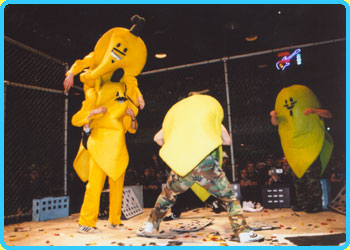

 Doris, I wasn't aware of that. I call Mike Piazza, Mike. I call Ichiro, Ichiro! I wasn't really aware of that. But I'm not exactly sure you're right. I'm sure there are others.
  [Mike:"She's a nice girl. She's a Virginian." Sheez, and people say I'm too tough on the guy. Doris, you finkosaurus. Talk about minutiae! As long as we can tell to whom he's referring, who cares? "Ichiro? Is that Ichiro Smith? Oh dear!"
  [Mike:First, they are not the same team as last year: David Ortiz, their best pure power hitter, is gone. Add Torii Hunter's off first half and you get a dropoff from sixth to eighth in the majors in slugging. However, they have gone from 16th to ninth in on-base to compensate.
 [Mike:From the Elaine Bennis School of Excessive Exclamation Points!!!!!!!!!!!]
 [Mike: Right, brawls may do more physical damage but they do not harm the integrity of the game itself.]
 [Mike: Ah, Joe the fences at Riverfront were 12 feet from 1970 to 1983 but were lowered to 8 feet in 1984. Of course, that was after you left, but it was twenty years ago.
 [Mike: One Joe Morgan special to go, Mel!
 [Mike: When the man's right, he's right. It's easy to become cynical about the rule when all it asks is that lip service be paid to the hiring of minority candidates, but a number of useful social programs started as half-hearted sops for one group or another. It could be stronger but if it gets one worthy minority a job, then it's a good thing. (Thank you, Martha Stewart, just for being you.)]
 [Mike: I may be too rough on Joe here scoring this a "Bad". The Dodgers did have a pretty dreadful offense in 1988 (tied for third from last in the NL in OBP, 5th from last in slugging, and 4h from last in OPS), they lost their best offensive player for most of the Series, and still were MLB's champ that year.
 [Mike: Huh? No, they already have Beltran. The guy wants to know if they should trade him or not.